
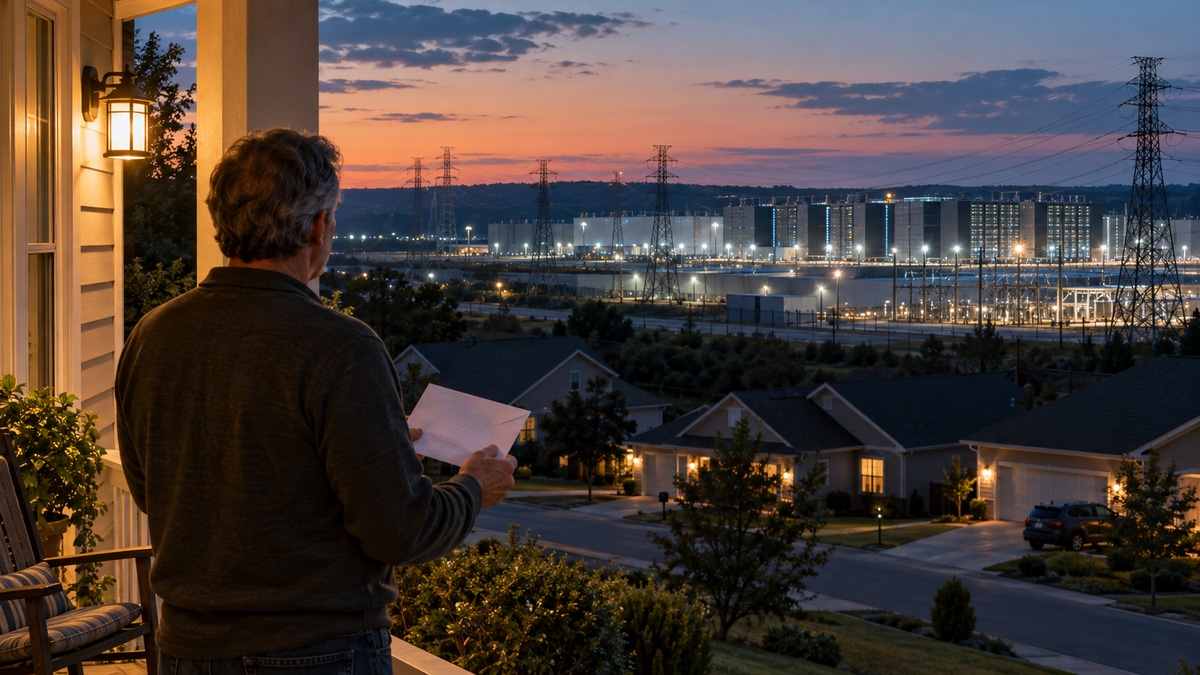
The House has put a number on the argument over who pays to power the AI buildout: 100 megawatts.

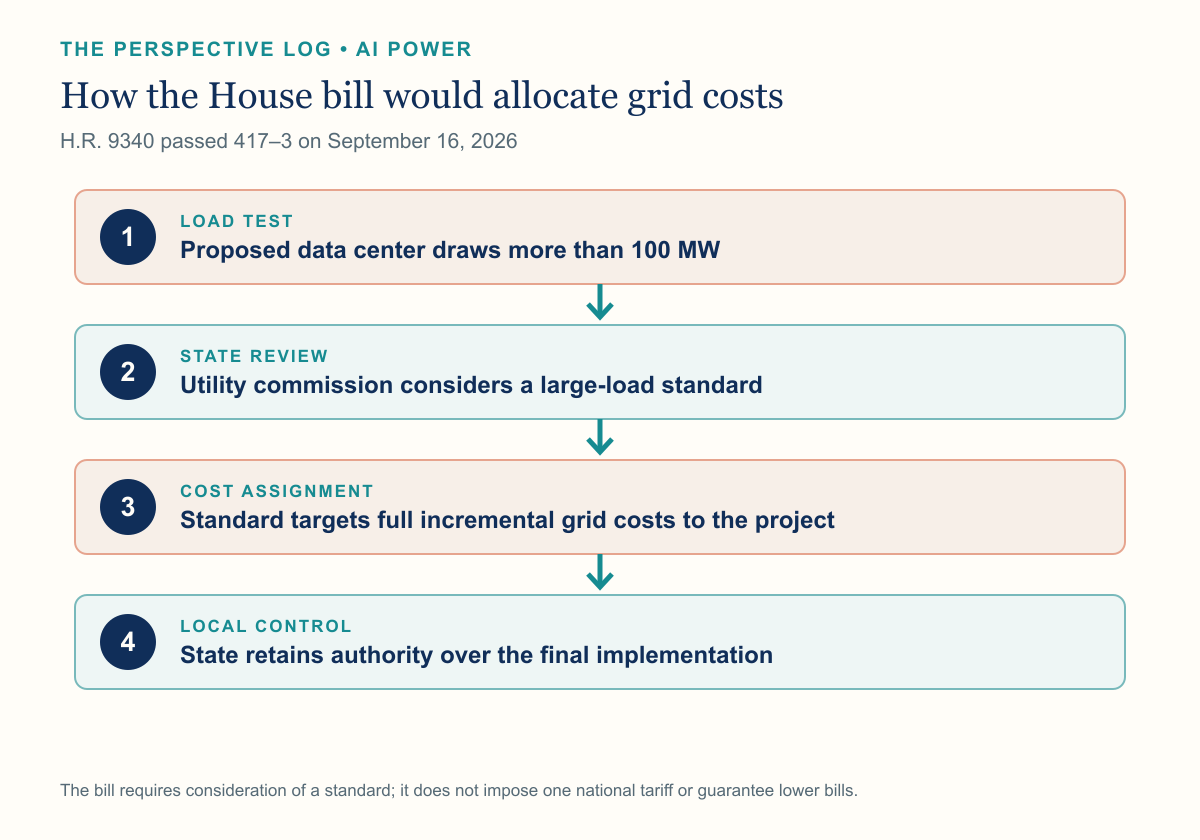
On Wednesday, representatives approved the Ratepayer Protection Act 417–3. The bill would tell state utility commissions to consider special rules for data centers drawing more than 100 MW, with the goal of charging those projects the full incremental cost of the generation, transmission and local upgrades built to serve them.
That is a meaningful policy signal. It is not yet law, and it does not create one national electricity rate. For households and investors, the immediate value is knowing where the cost fight is moving: from broad promises by technology companies into utility contracts, state proceedings and project economics.
What changed
H.R. 9340 passed the House on September 16 by a vote of 417–3. The unusually wide margin makes the political message clearer than the legal effect: lawmakers in both parties want AI infrastructure to expand without shifting its grid costs to residential customers and small businesses.
The mechanism is deliberately narrow. The bill would use Section 111(d) of the Public Utility Regulatory Policies Act to require state regulators to consider a large-load standard. Covered data centers would be those drawing more than 100 MW. The proposed standard is designed to make the large customer pay the full incremental cost of the infrastructure needed to serve that load.
“Consider” matters. State commissions would retain authority over electricity markets, and the legislation would not automatically dictate the final tariff, contract term or bill credit in every jurisdiction. The Senate would also have to act, and the president would have to sign the measure, before it became law.
Why it matters
AI companies do not plug new campuses into an unlimited power supply. A large project can require new generation, transmission, substations and local distribution work. Someone finances that construction, and utility regulation determines which customers ultimately bear the cost and risk.
The household concern is cost allocation. If infrastructure built for one very large customer enters the utility rate base without adequate protections, other customers can be exposed to higher charges. The risk becomes sharper if a proposed data center is delayed, uses less power than forecast or leaves before long-lived grid assets are paid off.
For technology companies, a stronger “cost causer pays” rule changes site economics. Deposits, minimum-bill provisions, collateral, long contracts and exit fees can increase the upfront cost of a campus. They can also make the economics more honest by pricing grid capacity into the project rather than distributing it across customers who did not create the load.
For utilities, the bill points toward a new class of customer agreement. The opportunity is real: a committed large load can support investment and expand the system. The danger is underwriting a speculative forecast with household balance sheets.
The case
The strongest case for the bill is not anti-AI. It is that price signals should survive the AI boom.
If a data center needs a dedicated substation or accelerates a transmission project, assigning those incremental costs to the project makes managers compare sites, power sources and designs on a fuller economic basis. That can reward locations with existing capacity and projects able to shift demand, build generation or commit for long enough to justify the investment.
Clear large-load rules can also reduce political friction. Communities are more likely to support projects when the contract specifies who pays for upgrades and what happens if demand falls short. A standard can give utilities, developers and regulators a common checklist before construction begins.
The 100-MW threshold also gives investors a practical screening question. When a technology company announces a campus, ask whether its power agreement covers incremental generation, transmission and interconnection costs. When a utility announces load growth, ask how much is backed by deposits, minimum payments and creditworthy counterparties.
Those details help separate durable revenue from a headline demand forecast. They also reveal which companies can secure power without damaging local support—an increasingly important constraint on AI capital spending.
The other view
A federal instruction to consider a standard can still produce a patchwork. States have different utility structures, generation mixes and growth needs. A rule that fits a regulated utility may not translate neatly to a competitive market or a municipal system.
There is also a timing risk. If regulators impose requirements slowly or inconsistently, projects may migrate to jurisdictions with faster approvals rather than to sites with the best grid economics. That could concentrate development or delay infrastructure that would eventually benefit other customers.
Large customers can provide benefits as well as costs. Their taxes, long-term purchases and willingness to fund new capacity may support jobs and modernize a local grid. The relevant question is not whether a data center uses a great deal of power. It is whether the contract captures both the costs and the benefits without leaving households with an asymmetric downside.
Finally, passage by the House is only one step. The Senate could change the text, decline to act or pursue a different approach. Investors should not model the proposal as enacted policy.
What to watch next
First, watch the Senate. The House vote shows broad support, but legislative timing and any changes to the 100-MW definition, cost standard or state process will determine the bill’s practical reach.
Second, follow state utility dockets. The bill’s real-world effect would emerge in tariffs and special contracts: deposits, minimum monthly bills, construction contributions, contract lengths, collateral and protections against stranded assets.
Third, read technology-company power announcements for obligations rather than aspiration. A promise to “pay our way” is stronger when a filing or approved contract states which grid upgrades the company funds and what happens if the campus is delayed.
Fourth, examine utilities’ load forecasts. The key distinction is contracted demand versus an inquiry queue. Capital plans built on signed, credit-supported commitments deserve more confidence than plans built on prospective requests.
Decision in 30 seconds
The House passed H.R. 9340 by 417–3. It would require state utility commissions to consider a large-load standard for data centers above 100 MW, aimed at assigning the full incremental cost of new generation, transmission and local upgrades to the project that causes them. It does not automatically set rates, guarantee lower bills or become law without Senate and presidential action. Households should watch state rate cases; investors should examine the power-contract terms behind every major AI campus announcement.
Primary sources
- House Energy and Commerce Committee, September 16 passage release
- House Energy and Commerce Committee, June 18 introduction and bill summary
- Associated Press, September 16 report
This article is general information, not individualized investment or utility-rate advice. The bill has passed the House but has not been enacted.
