

The Federal Reserve has changed the direction of travel. On September 16, the Federal Open Market Committee raised its target range by a quarter percentage point to 3.75%–4.00%, the first increase in three years. The vote was unanimous.

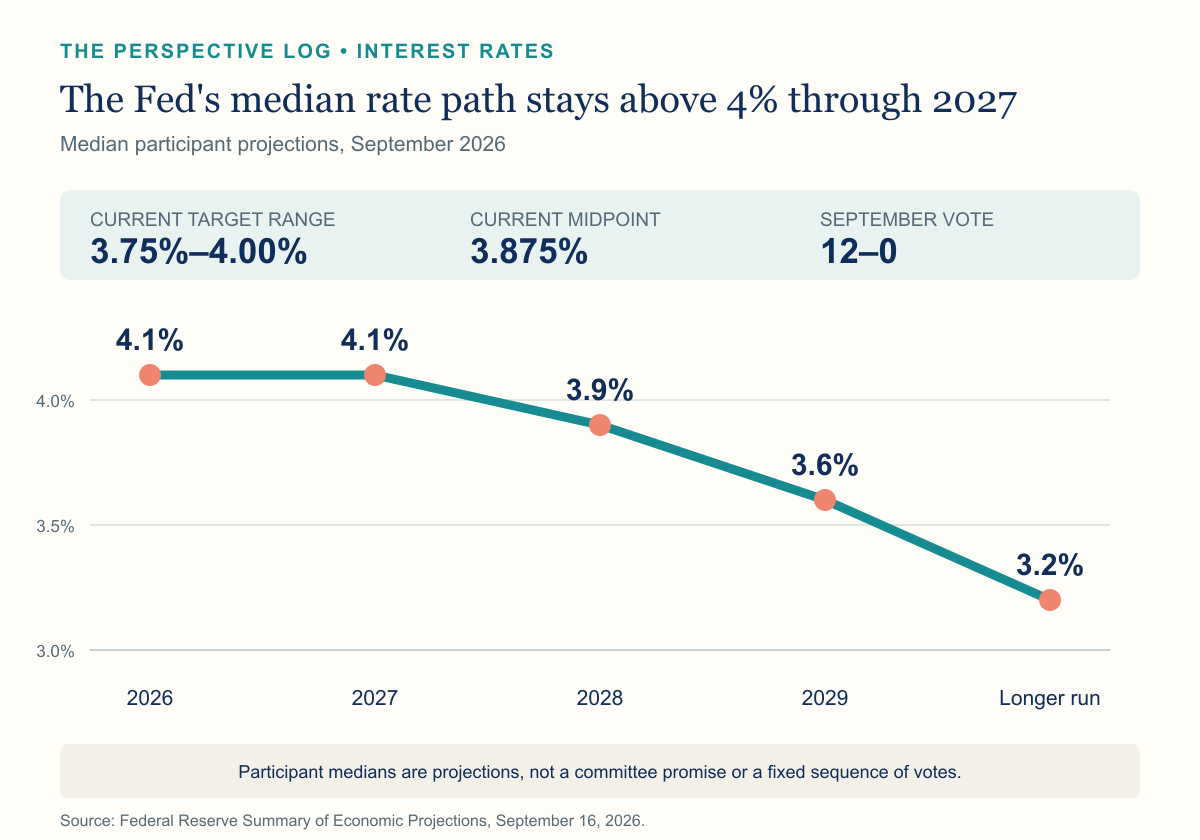
The quarter point matters, but the more consequential signal sits in the new projections. The median participant expects the federal funds rate to end 2026 at 4.1%, above the current range midpoint of 3.875%, and remain at 4.1% through the end of 2027. That is consistent with another quarter-point increase this year, although it is not a promise and the projection is rounded.
For households and investors, this is a regime change in miniature. Waiting for cheaper credit has become a less comfortable strategy. Cash yields may remain useful for longer. Companies whose valuations depend heavily on distant profits face a higher hurdle rate, while banks, insurers and cash-rich businesses get a different earnings equation.
What changed
The FOMC raised the target range by 0.25 percentage point to 3.75%–4.00%. Its statement described economic activity as expanding at a solid pace, domestic spending as resilient, productivity growth as strong and capital investment as robust. It also said inflation remains elevated and that the increase would support a timelier return to the 2% goal.
The accompanying Summary of Economic Projections sharpened the message. The median projected federal funds rate is now 4.1% for both 2026 and 2027, then 3.9% in 2028, 3.6% in 2029 and 3.2% over the longer run. In June, the comparable medians were 3.8% for 2026, 3.6% for 2027, 3.4% for 2028 and 3.1% over the longer run.
That revision is larger than the single meeting move. It says the typical participant now sees rates staying materially higher across several years than they did three months ago.
The economic projections explain why. Median 2026 real GDP growth rose to 2.3% from 2.2% in June, while the projected unemployment rate fell to 4.1% from 4.3%. At the same time, median PCE inflation edged up to 3.7%, and core PCE inflation rose to 3.4%. The Fed is describing an economy strong enough to absorb tighter policy and inflation persistent enough to require it.
Why it matters
Borrowers should stop treating lower rates as the base case
The federal funds rate does not directly set a mortgage, auto loan or credit-card APR. Banks price products using funding costs, Treasury yields, credit risk, competition and other inputs. But a higher policy path raises the floor under short-term borrowing costs and can influence longer-term yields.
The simple sensitivity is easy to understand. A quarter percentage point equals $25 a year per $10,000 of balance, $125 per $50,000 and $250 per $100,000 if the change passes through for a full year. Actual loan payments can behave very differently, especially for amortizing fixed-rate mortgages, so those figures are illustrations rather than product forecasts.
The decision implication is practical: compare the cost of waiting with the cost of acting. A household considering a variable-rate balance, a home-equity line or a large purchase should not assume that financing will become cheaper within a few months. Refinancing remains an option later; a plan that only works if rates fall is not much of a plan.
Savers may keep getting paid to wait
The other side of high short-term rates is that cash and short-duration instruments can remain competitive. Treasury bills, money-market funds and high-yield savings accounts do not automatically match the federal funds rate, and their yields can change quickly. Still, a projected policy rate above 4% through 2027 supports the case for maintaining a deliberate liquidity bucket rather than stretching for yield in riskier assets.
This does not mean cash is a complete investment strategy. Inflation erodes purchasing power, reinvestment rates can fall and long-term portfolios still need growth. It means the opportunity cost of holding near-term spending reserves is lower than it was in a near-zero-rate world.
Stock valuations face a higher discount rate
Higher interest rates make future corporate cash flows worth less in present-value terms, all else equal. That pressure is most visible in long-duration growth stocks, highly leveraged companies and business models that need repeated financing. It also raises the benchmark that every capital project must beat.
The effect is not uniformly negative. Banks can benefit from wider lending spreads if deposit costs and credit losses remain controlled. Insurers can reinvest premiums at higher yields. Companies with large net-cash positions may earn more interest income. The useful portfolio question is not simply “Are rates up?” It is “Which holdings need cheap money, and which holdings are paid more when money is expensive?”
The case
The case for taking the new path seriously rests on the combination of the statement and the projections. The committee did not describe a collapsing economy that required support. It described solid activity, resilient spending, strong productivity and robust investment. The median participant simultaneously marked up growth, marked down unemployment and projected higher inflation and policy rates.
That mix points to restrictive policy lasting longer. If activity remains firm while inflation is above target, officials have less reason to reverse course quickly. The median 4.1% rate for both 2026 and 2027 is the clearest expression of that view.
For investors, the case favors balance-sheet quality and pricing power over stories that depend on distant profits or frequent refinancing. For households, it favors paying down expensive floating-rate debt, keeping planned near-term spending out of volatile assets and shopping aggressively for deposit and loan rates.
The other view
The dot plot is not a committee commitment. Eighteen participants submitted individual projections based on their own assessments of appropriate policy. The median can shift when the data shift, and it does not reveal a binding sequence of future votes.
The longer-run direction in the same projections is downward: 3.9% in 2028, 3.6% in 2029 and 3.2% over the longer run. If inflation cools faster than expected, growth weakens or labor-market risks rise, the Fed can stop or reverse course. Long-term market rates also incorporate global capital flows and expectations that reach far beyond the next FOMC meeting.
There is another counterweight. Strong productivity and capital investment could allow the economy to grow faster without generating the same inflation pressure. If that optimistic supply-side story holds, today’s higher rate path may prove temporary.
Those caveats argue against extrapolating one hike forever. They do not justify building a household or portfolio plan around imminent cuts.
What to watch next
First, watch inflation data, especially PCE inflation. The September projections put headline PCE inflation at 3.7% and core at 3.4% for 2026, both well above the 2% objective. A sustained downside surprise would weaken the case for another increase; renewed acceleration would strengthen it.
Second, watch whether the labor market remains as firm as projected. The median unemployment rate is 4.1% in every year from 2026 through 2029. A material rise would change the balance between price stability and maximum employment.
Third, watch market rates and credit spreads rather than the policy rate alone. Mortgage costs, corporate financing conditions and equity valuations respond to the entire yield curve and to risk premiums. Nasdaq’s September 18 review noted the 10-year Treasury yield near 5%, around its highest level since 2007. That market signal can tighten financial conditions even without another FOMC vote.
Finally, watch the October 27–28 and December 8–9 FOMC meetings. The 4.1% year-end median is consistent with one more quarter-point move from the current midpoint, but officials still have two scheduled decisions and incoming data before the year closes.
Decision in 30 seconds
Do not assume the September increase is a one-off. The Fed’s median projection points to a policy rate around 4.1% at the end of both 2026 and 2027, versus a current midpoint of 3.875%.
If you borrow, test the payment at today’s rate and at least another quarter point higher. If you save, compare what insured deposits, Treasury bills and money-market funds actually pay after fees and taxes. If you invest, identify which holdings require cheap refinancing or distant profits to justify their price.
The message is not that rates can only rise. It is that “cuts soon” is no longer a sound default assumption.
*Jasper Kellan is editor of The Perspective Log. This article is general information, not personal investment, tax or legal advice. Published September 19, 2026.*
Primary sources
- Federal Reserve — FOMC statement, September 16, 2026
- Federal Reserve — Summary of Economic Projections, September 16, 2026
- Federal Reserve — FOMC calendars and meeting materials
- Nasdaq Economic Institute — Chartstopper, September 18, 2026
