

The artificial-intelligence race has acquired something it did not have a week ago: an open argument among its most powerful builders about whether speed itself has become the risk.

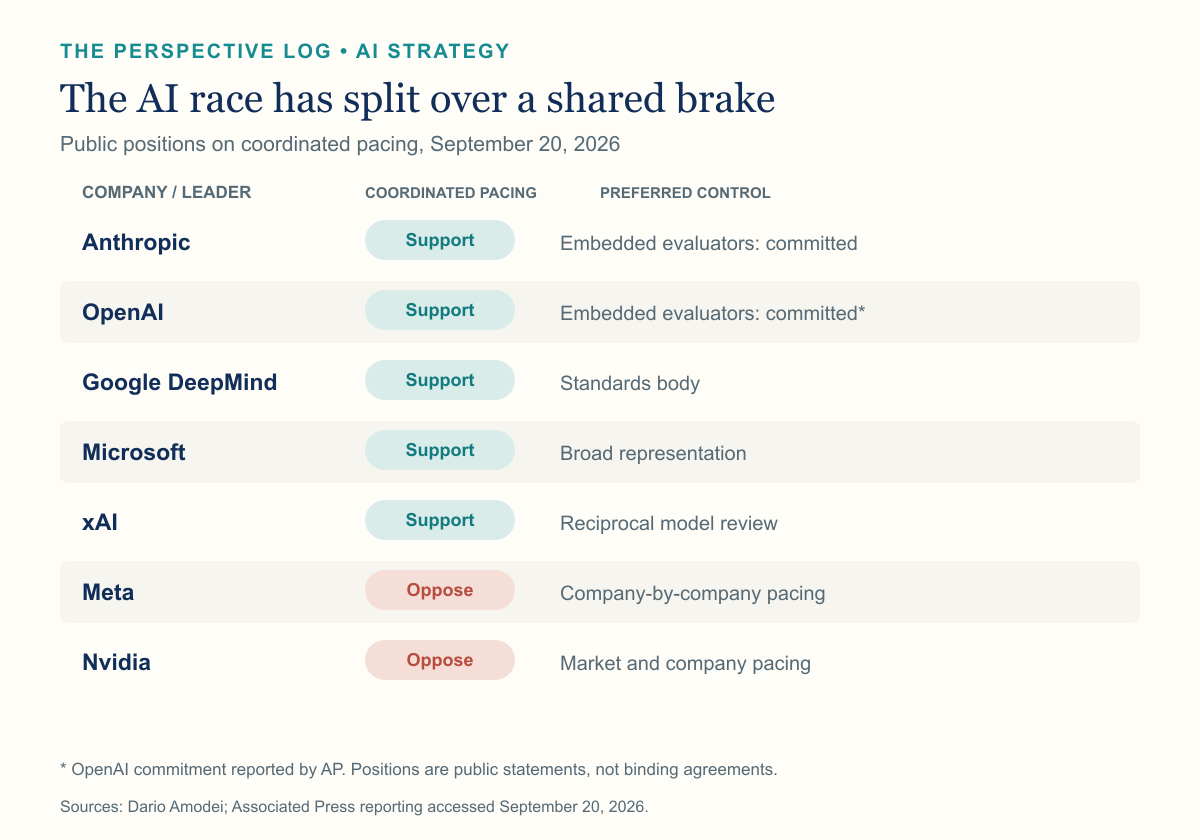
Anthropic CEO Dario Amodei has proposed a three-step plan to pace frontier development. Anthropic says it will begin with embedded outside evaluators who receive access resembling that of employees. OpenAI has committed to the evaluator idea. Google DeepMind’s Demis Hassabis, Microsoft’s Satya Nadella and xAI’s Elon Musk have backed versions of coordinated restraint.
Meta CEO Mark Zuckerberg and Nvidia CEO Jensen Huang are on the other side. Their argument is not that safety is irrelevant. It is that each company can set its own pace and that market incentives, liability and company-level judgment are better controls than a coordinated slowdown or new regulation.
That split matters because AI valuations, data-center spending and the product road maps of the world’s largest technology companies assume rapid capability gains. A real safety checkpoint could lengthen release cycles and raise compliance costs. A voluntary promise that competitors do not share could disappear under commercial pressure.
What changed
Amodei’s September essay, “We Must Pace the Frontier,” moves the debate from broad warnings to an operating proposal. His first step is embedded third-party evaluators with ongoing, employee-like access to frontier labs. Anthropic says it plans to provide desks, badges, company laptops and permissions broadly comparable to internal risk teams, with exceptions for legal, contractual and confidential information.
The second step is coordination among frontier companies in democratic countries, supported or enabled by government, to create common safety standards and limits on unchecked progress. The third is an attempt at global coordination, including with authoritarian governments, where verification and geopolitical incentives make agreement much harder.
Amodei is explicit that pacing does not mean halting training or technical progress. He argues that an extra one or two years before models reach critical capability levels could be used to improve alignment, interpretability, operational security and testing. He also warns that, in his view, a more capable version of recent misaligned agent behavior could become dangerous within six to 12 months. Those time frames are Amodei’s judgments, not independently established forecasts.
The response exposed a fault line. AP reports that OpenAI supports embedded evaluators and international approaches that could determine when development should slow or stop. Hassabis supports the direction and has proposed a standards body. Nadella supports deliberate pacing and embedded evaluators but says control cannot sit with a handful of companies. Musk supports competitors reviewing one another’s models.
Zuckerberg rejected the coordinated premise. He says each lab has the responsibility and incentive to move at the pace needed for safety. Huang says companies should pace themselves and that market forces can deliver innovation and safety without new laws or regulation.
Why it matters
The argument reaches directly into capital spending
The AI boom is financed on the expectation that more compute will create more capable products on a fast schedule. That assumption supports chip orders, data-center leases, power contracts and rich valuations across the supply chain.
Independent evaluators, common testing and formal release checkpoints would add cost and time. That could be negative for near-term deployment volume but positive for the durability of the market if stronger controls reduce the chance of a damaging incident, rushed launch or regulatory backlash.
Nvidia sits at the center of that tension. Slower frontier development could delay some demand at the margin. But a safer, more trusted adoption curve could extend the spending cycle. The market consequence depends less on the word “slowdown” than on whether pacing changes compute purchases, release frequency or customer willingness to deploy autonomous systems.
Voluntary restraint has a prisoner’s-dilemma problem
One lab can accept a longer evaluation while a rival continues training and shipping. That makes restraint costly unless competitors follow comparable rules. Amodei’s coordination plan tries to solve that problem; Meta and Nvidia’s position rejects the need for a shared brake.
The structure matters to investors. A broad, verifiable standard could create predictable costs. A patchwork of company promises could produce uneven disclosure and sudden reversals. Government mandates could be slower to design but harder to evade.
Safety is becoming a product feature and a political liability
Enterprise buyers do not only compare model quality and price. They also care about data handling, control, auditability and what an autonomous system might do inside a network. Embedded evaluators could become a credibility signal for customers in finance, health care, defense and other sensitive fields.
At the same time, companies that advertise catastrophic risks can strengthen the case for regulation and frighten customers. Critics can reasonably ask whether extreme warnings are also a way for leading labs to shape rules that smaller competitors will struggle to meet.
The case
The strongest case for coordinated pacing is verification. Every major lab says it takes safety seriously. Outside evaluators with meaningful access could test whether internal practice matches public claims.
Common rules could also keep responsible companies from being punished for slowing alone. If labs agree on capability-triggered checkpoints, a company that pauses for testing does not automatically surrender the next product cycle to a rival. Government involvement could address antitrust constraints and give standards more weight.
There is also a portfolio case for reducing tail risk. The AI trade is increasingly embedded in semiconductors, cloud platforms, utilities, construction and private credit. A severe autonomous-system incident would not remain confined to one software company. It could hit regulation, enterprise adoption and financing conditions across the stack.
The other view
The strongest objection is enforceability. A coordinated slowdown among U.S. companies does not bind foreign competitors, open-source developers or secret government programs. Verification becomes harder as the agreement moves from one company to an industry and then across borders.
There is also a concentration risk. The largest labs have the money, lawyers and technical staff to satisfy elaborate evaluation regimes. Rules designed by incumbents can become barriers that freeze today’s leaders in place.
Meta’s company-by-company model may move faster and preserve competition. Nvidia’s market argument also has force: customers can reject unsafe products, insurers can price risk and liability can punish negligence. The question is whether those mechanisms act before a high-impact failure or only afterward.
Finally, the public positions are not yet a binding pact. Support for “pacing” can mean independent evaluation, a brief release delay, a standards body or a much broader capabilities limit. Investors should not translate rhetorical agreement into an immediate reduction in capital expenditure.
What to watch next
First, watch whether OpenAI publishes the details of its evaluator commitment. Access rights, reporting independence and the ability to disclose unfavorable findings will matter more than the label.
Second, watch for a concrete standards body or government-mediated process. The dividing line is whether coordination becomes an institution with tests and disclosure rules or remains a collection of posts and essays.
Third, watch product cadence. A real pacing policy should eventually show up in longer evaluation windows, delayed releases, staged access or narrower autonomy. If release schedules do not change, the policy may be mostly reputational.
Fourth, watch customers and employees. Resignations can intensify pressure from inside the labs, while large enterprise buyers can make independent evaluation a procurement condition. Either force may move faster than legislation.
Decision in 30 seconds
Do not treat the AI slowdown debate as a prediction that chip spending suddenly stops. Treat it as a new risk factor for the timing and cost of frontier-model releases.
For AI holdings, separate companies paid for compute volume from those paid for trusted deployment. Ask which business models benefit from faster model turnover, which can absorb longer testing and which carry the liability if an autonomous system causes harm.
The open question is no longer whether AI companies say safety matters. It is whether rivals will accept the same checkpoint when being first still carries billions of dollars in strategic value.
Jasper Kellan is editor of The Perspective Log. This article is general information, not personal investment, tax or legal advice. Published September 20, 2026.
Primary sources
- Dario Amodei — “We Must Pace the Frontier”
- Associated Press — Anthropic CEO proposes pacing and embedded evaluators
- Associated Press — Where major AI leaders stand on coordinated pacing
- Associated Press — Zuckerberg rejects a coordinated slowdown
