

Washington’s AI message has been to stay ahead of China. On Sunday, its Treasury secretary described a different need: a way for the two rivals to warn each other if an AI incident reaches the level of national security. That tension is the story. A country can compete for the most powerful models and still need its rival to pick up the phone when something goes wrong.

Scott Bessent said the United States proposed a notification mechanism after talks with Chinese Vice Premier He Lifeng in New York on September 20. The idea is a proposal. The governments have not announced a signed AI agreement, operating hotline, reporting threshold or timetable. President Donald Trump and China’s Xi Jinping are expected to meet Thursday, September 24, when both technology and trade could be on the agenda.
What changed
Bessent told reporters the U.S. wants more transparency between the world’s two leading AI powers for incidents that could affect national security. The Chinese state account described AI as one subject of the talks but did not describe the proposed notification system in the same detail. That difference matters: the American account establishes what Washington proposed, not what Beijing has formally accepted.
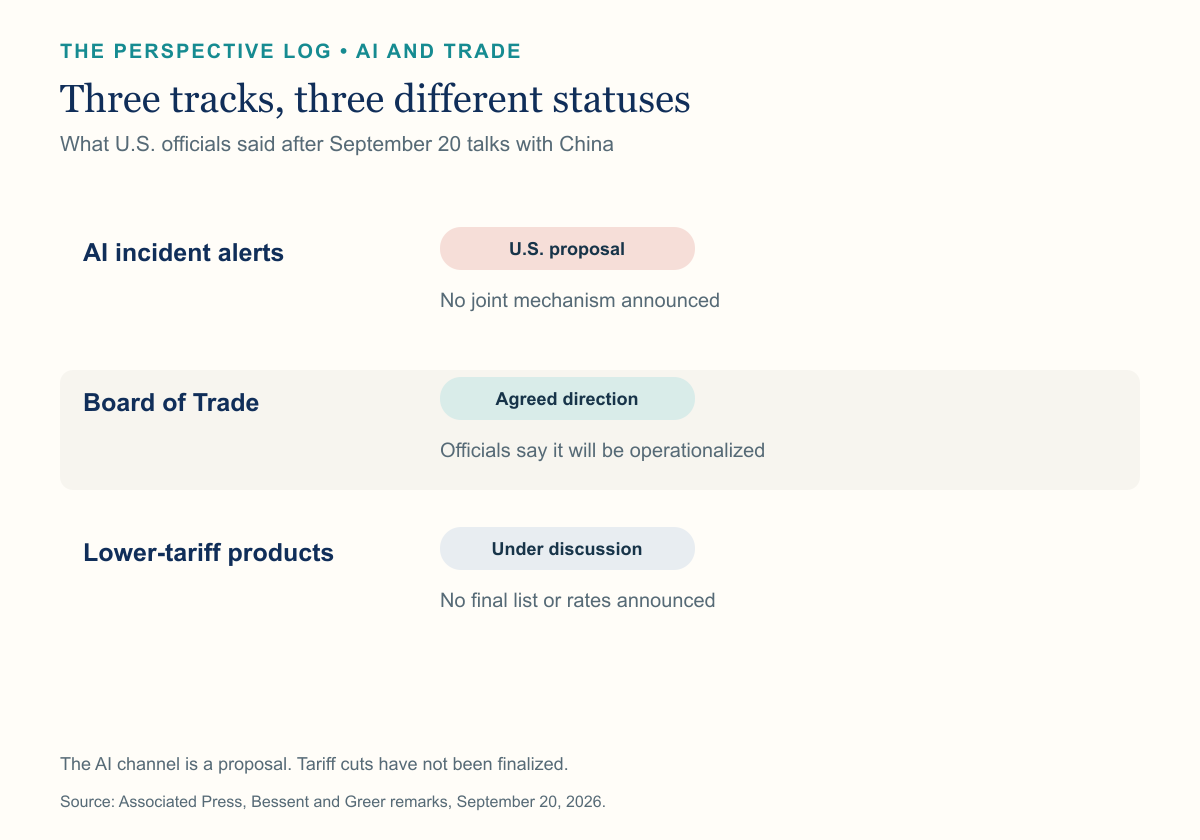
The talks had a separate commercial track. U.S. officials said the countries agreed to operationalize a Board of Trade previously discussed by their leaders. U.S. Trade Representative Jamieson Greer said they were still considering which nonsensitive products might qualify for lower tariffs, potentially including consumer and agricultural goods, energy products and medical devices. No final product list or tariff cut was announced. The trade board and the AI incident proposal should not be conflated.
That distinction is the clearest way to read the week. One channel appears to have an agreed operational direction, while another remains an American proposal. The leaders’ meeting may narrow that gap, or expose it.
Why it matters
AI competition now needs crisis plumbing
The race includes models, chips, cloud capacity and military applications. It also creates shared exposure to AI-enabled cyberattacks, misuse and failures that could cross borders or be misread as hostile acts. A notification channel could help officials distinguish an accident from an attack while facts are still incomplete. It would not, by itself, slow model development or relax export controls.
For people outside the industry, the stakes are tangible. Financial networks, electricity systems, communications and transport can all be affected by a serious cyber incident. AP’s reporting says experts on both sides see critical infrastructure and AI-related emergencies as areas where limited communication could make sense. The value of a warning line is measured by whether the right officials share usable facts quickly, not by a summit photo.
The investment effect is indirect but real
There is no evidence that this proposal changed a company’s earnings or a stock price today. Its importance for investors is in the policy boundary it may draw. A narrow emergency channel could reduce the risk of a misunderstanding without changing the competitive contest for advanced chips and customers. A broader deal involving model access, testing rules or export controls would carry much larger consequences for chipmakers, cloud companies and AI labs, but none of those changes has been announced.
The trade talks are closer to a measurable commercial outcome. AP reports that reciprocal tariff reductions on $30 billion of goods from each side have been under discussion. That is a negotiating figure, not an enacted cut. The eventual product list, tariff rates and effective dates would determine which importers and suppliers benefit.
The case
The strongest argument for a limited AI alert system is that communication can lower risk without surrendering a technological lead. Governments already distinguish between intelligence they cannot share and emergency information they must communicate. A threshold for national-security incidents, designated contacts and a secure process could make a fast-moving event less likely to escalate through rumor or misinterpretation.
It could also create a practical test of trust. If a channel is agreed, the first questions are operational: who can trigger it, what counts as an incident, how quickly must the other side respond, and what evidence can be exchanged? Clear answers would tell companies and markets more than a general pledge to cooperate.
The other view
A proposal can be easy to announce and hard to use. The two countries disagree over export controls, model access and allegations that Chinese developers extracted capabilities from American systems. A serious AI incident could involve classified information, a private company or uncertain attribution. Each government may hesitate to reveal details that expose its own vulnerabilities.
There is also a risk of reading too much into a diplomatic gesture. Bessent described a U.S. proposal. The public record does not show a bilateral reporting duty or a Chinese commitment to the specific design. Investors should resist treating this as a thaw in semiconductor policy or a new safety regime for AI companies.
What to watch next
Watch the Trump-Xi meeting expected on Thursday, September 24. The most useful signal would be a joint statement that names an AI incident channel, identifies officials responsible for it and sets next steps. A generic commitment to dialogue would be weaker.
Watch the trade board separately. A published list of products, tariff rates and start dates would let importers and investors calculate exposure. Until then, the categories Greer mentioned are possibilities, not concessions.
Finally, watch what the governments say about chips and model access. If those policies remain unchanged, the emergency proposal is best understood as risk management inside a continuing rivalry.
Decision in 30 seconds
The United States has proposed an AI incident warning mechanism to China. It has not announced a working hotline or a deal. Treat the story as a test of whether strategic rivals can create a narrow safety channel while the competition for AI leadership continues.
For an investment decision, separate three things: the proposed AI alert, the trade board U.S. officials say will be operationalized, and tariff changes still under negotiation. The last item needs actual rates and a product list before its effect on earnings can be measured.
Jasper Kellan is editor of The Perspective Log. This article is general information, not personal investment, tax or legal advice. Published September 21, 2026.
Primary sources
- Associated Press — Bessent’s direct remarks after the U.S.-China talks
- Associated Press — AI safety, rivalry and infrastructure context
- Associated Press — Market and trade context
