

Microsoft is trying to turn Copilot from software people consult into labor that keeps moving after they leave. Its new Autopilot can watch channels, follow up on threads and resume projects days later. Code lets non-developers describe an app or workflow and have Copilot build it. Home puts that work beside Word, Excel and PowerPoint.

The thesis is simple: the next enterprise-AI battle is not about who writes the best answer. It is about who owns the workflow, the runtime and the bill. Microsoft has a structural advantage because those three pieces can now sit inside the same Microsoft 365 tenant. The risk is equally structural: persistent agents consume compute, touch sensitive systems and create variable costs even when nobody is typing a prompt.
What changed
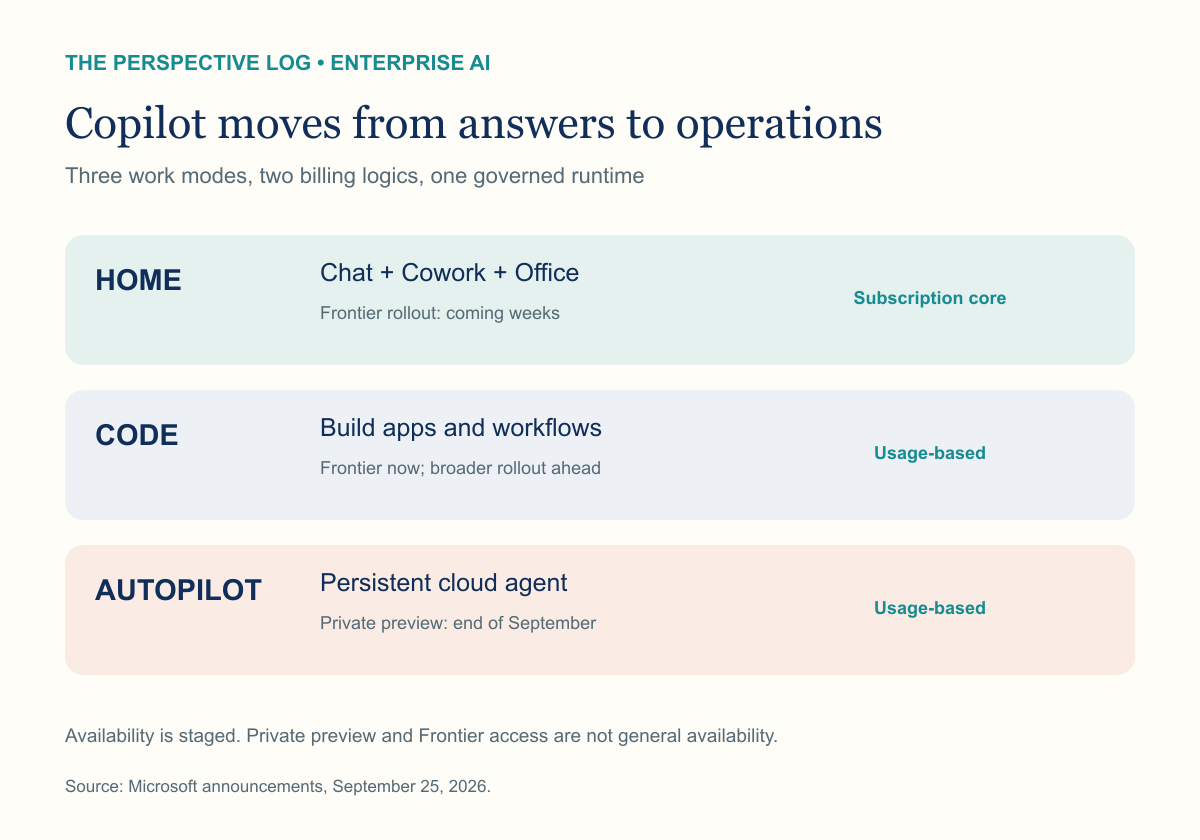
On September 25, Microsoft introduced three Copilot capabilities: Home, Code and Autopilot. Home brings Chat and Cowork into one starting point and embeds editable Word, Excel and PowerPoint work inside the Copilot experience. Code lets a user request a tracker, dashboard, automation or internal app in natural language. Autopilot, previously called Scout, is a cloud-hosted agent that Microsoft says can keep working without waiting for the next prompt.
The rollout is staged, not universal. Home and Code are entering Microsoft’s Frontier program in the coming weeks. Microsoft says Code should reach broader availability in the following weeks and a preview for Microsoft 365 Premium and Pro subscribers later this year. Autopilot is expanding to private preview at the end of September.
Microsoft also put the operating layer into public preview. Copilot Managed Runtime is designed to run code inside the Microsoft 365 tenant boundary, with Entra identity, governed data access, approved connectors, auditability, versioning and centralized inventory. That matters because generating an app is the easy demo; controlling what it can access after deployment is the enterprise problem.
Why it matters
This changes the economic unit Microsoft is selling. A conventional productivity subscription charges for a seat. A persistent agent charges for activity: model use, context retrieval, tool calls and runtime. Microsoft says everyday Copilot use remains within a user subscription license, while Cowork, Code and Autopilot run on usage-based billing.
That split can expand revenue beyond the number of employees licensed. A company with 10,000 knowledge workers still has 10,000 seats, but the number and duration of autonomous tasks can grow with every process those workers delegate. Microsoft gains a second meter inside the same customer relationship.
For buyers, the promise is leverage. A supplier review that once required schedules, reminders, meetings and follow-ups could become a standing agent assignment. An operations team could generate a purpose-built internal tool instead of waiting in a development queue. The value is not a prettier draft. It is elapsed time removed from a process.
The cost problem arrives at the same moment. Microsoft’s September announcement gives administrators budgets, policies and usage visibility, but it does not give every buyer a simple universal price for a completed task. The return depends on whether a workflow saves more labor and delay than it consumes in credits, supervision and remediation.
The case
Microsoft’s strongest advantage is distribution plus context. Copilot already sits across Word, Excel, PowerPoint, Outlook and Teams. Fabric IQ can bring what Microsoft describes as more than 20 million Power BI semantic models into Copilot. Plugins add actions, and Managed Runtime supplies a governed place to run what users build.
That stack can shorten the distance between intent and execution. A request begins in the same environment where documents, meetings, permissions and business data already live. If the agent can inherit the right context and controls, the customer avoids stitching together a model, orchestration layer, identity system, hosting platform and audit trail.
There is also a defensive logic. If employees are going to build small AI-generated apps anyway, IT would rather see them in one inventory than discover them scattered across consumer tools and unmanaged clouds. Microsoft is betting that governance will be the reason enterprises permit more autonomy, not merely the brake that slows it.
The other view
The launch is still heavy on previews and company claims. Autopilot is not broadly available. Code’s broad rollout is ahead, not complete. A generated app running inside a tenant can still be wrong, over-permissioned or expensive. Central governance reduces some risks; it does not eliminate the need to design access, test outputs and assign human accountability.
Usage-based billing also creates an uncomfortable incentive. Microsoft earns more when agents do more work. Customers benefit only when that activity produces measurable business value. A long-running agent that repeatedly searches, retries tools or asks other systems for context may look productive while accumulating cost.
Microsoft has tried to answer this with spending policies, model controls and FinOps dashboards. Those are necessary. They also confirm the central tension: autonomous work is not just a software feature. It is a new variable operating expense.
What to watch next
First, watch conversion from private preview to broad availability. Delays, narrow eligibility or heavy administrator setup would signal that the autonomy is harder to operationalize than the launch suggests.
Second, watch task-level economics. Buyers need comparable measures: completion rate, minutes of human review, rework, total credits and cycle time saved. “Agent usage” alone is not a success metric.
Third, watch permissions and incident reporting. Autopilot has its own identity, memory, computer and workspace. The decisive governance question is how quickly an administrator can see what it did, revoke access and reconstruct a failure.
Finally, watch whether Code creates durable internal software or a flood of disposable mini-apps. Central inventory and lifecycle controls become more valuable as creation gets easier, but the maintenance burden can grow just as fast.
Decision in 30 seconds
For investors: Microsoft is attaching a usage meter to the next layer of Office work. If autonomous tasks scale, revenue can grow faster than seat count. The evidence to demand is sustained usage with visible customer ROI, not preview enthusiasm.
For enterprise buyers: Start with one bounded process that has a known labor cost, clear permissions and a measurable completion standard. Cap spend, record human review time and compare the full task cost with the existing process before expanding.
For workers: The immediate change is not a robot replacing an entire role. It is software taking ownership of follow-ups, coordination and small internal tools. The valuable skill shifts toward defining objectives, constraints and acceptance criteria.
Primary sources
- Microsoft: Introducing the new Copilot with Home, Code and Autopilot
- Microsoft: Copilot Managed Runtime enters public preview
- Microsoft: Copilot Cowork pricing and cost controls
Microsoft’s descriptions, rollout dates and performance or cost statements are company claims. Preview access is not general availability. This analysis is informational and is not investment advice.
