
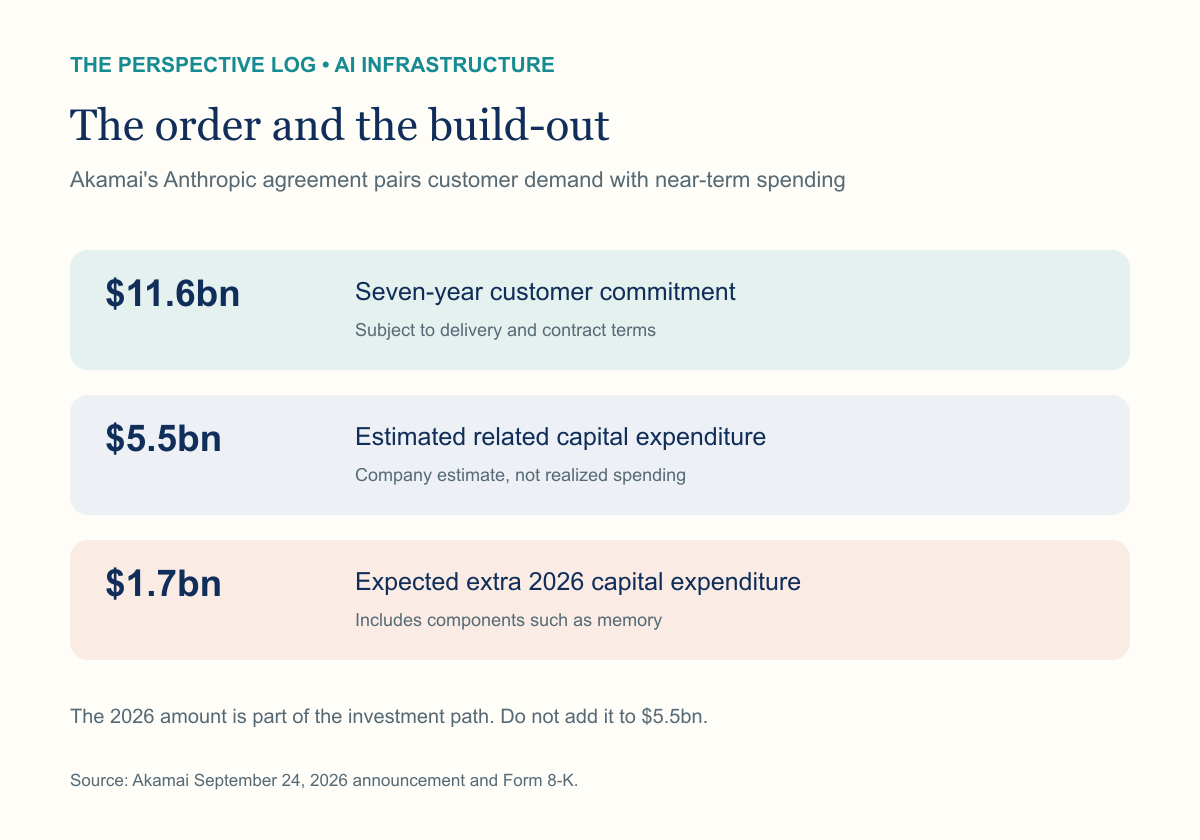
Anthropic has committed approximately $11.6 billion to Akamai cloud services over seven years. Akamai’s September 24 announcement made the number look like a clean win for an AI infrastructure supplier. The investment test begins sooner: Akamai expects to spend about $5.5 billion to serve the commitment, including roughly $1.7 billion of extra capital expenditure in 2026 to secure components such as memory.

The thesis is testable. If Akamai delivers the capacity on schedule and turns the customer commitment into attractive cash returns, this deal can validate its move deeper into AI cloud infrastructure. If component costs, delivery delays or service economics disappoint, the headline contract may mask a long and expensive build-out.
What changed
Akamai and Anthropic signed two project plans on September 18 under a master services agreement dating from May. Akamai disclosed them in a September 24 Form 8-K and announced an aggregate commitment of approximately $11.6 billion. Each plan has an initial seven-year term starting when its services begin. The filing makes the commitment subject to delivery, availability and termination provisions; it is neither current revenue nor guaranteed profit.
The capacity is aimed at Anthropic’s growing CPU workloads. That detail matters. AI spending is often reduced to GPUs, but model-serving systems also need CPU compute, memory, networking and managed operations. Akamai is offering distributed cloud capacity across its network rather than a single product shipment.
Akamai also issued Anthropic a warrant to buy non-voting preferred stock representing up to about 5% of common shares on an as-converted basis. A first portion representing about 2% is expected to vest after Anthropic’s first payment under one plan, subject to conditions. Three further portions depend on an additional $3 billion of contract value each. Anthropic must pay cash to exercise vested rights. The full stake is a possibility tied to expansion, not common stock already owned.
Why it matters
The visible cost arrives before the full stream of service payments. Akamai estimates about $5.5 billion in capital expenditure related to the announced $11.6 billion commitment. It expects about $1.7 billion of additional capex in 2026 to secure and pre-purchase supply-chain components, including memory, while saying its 2026 revenue guidance is unchanged.
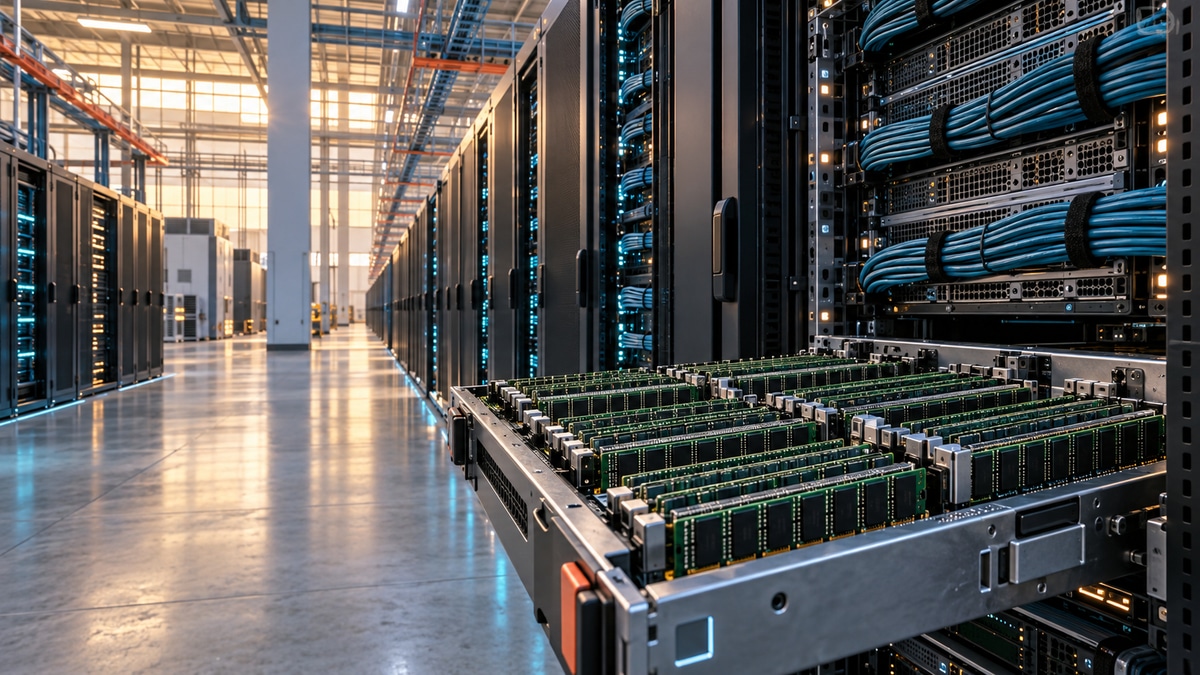
The September 24 filing gives that spending a physical form: Akamai authorized manufacturing partner Jabil to purchase about $1.7 billion of memory components, with Akamai paying supplier invoices as the parts arrive. This procurement figure should not be added to the separate $1.7 billion capex-guidance increase; the disclosures describe related parts of the same investment program, not two independent bills.
For investors, the relevant spread is not simply $11.6 billion minus $5.5 billion. The first figure is a multi-year customer payment commitment under contract conditions. The second is an estimate of capital spending. Neither captures operating costs, financing, depreciation, timing or the eventual margin. The next financial reports must show whether the new infrastructure earns enough to justify the cash Akamai deploys.
The case
The strongest argument for Akamai is an unusually large anchor customer. The deal creates a defined demand path for dedicated capacity, and Akamai says it sits alongside more than $2.8 billion of other multi-year cloud commitments announced across its customer base this year. If those workloads arrive as planned, purchasing hardware ahead of revenue could be rational rather than reckless.
The agreement also reaches beyond one initial order. Akamai says further purchases of up to $9 billion could raise the relationship’s potential value to about $20 billion. Each additional $3 billion of agreed cloud services would unlock another portion of Anthropic’s warrant. That mechanism aligns a larger potential equity interest with additional commercial commitments, though the expansion remains conditional and its terms still have to be agreed.
There is a human stake behind the server rows. AI users and enterprise customers care whether model services stay fast and available as demand grows. The companies that finance this capacity must make the same infrastructure reliable through a period of costly, constrained components. A delayed memory delivery can become both an operational problem for customers and a cash-flow problem for the supplier.
The other view
An anchor customer can also become a concentration risk. The filing describes service requirements and termination rights, including provisions related to material outages. A large order does not remove the work of bringing hardware online, operating it at promised service levels and retaining economic leverage when the customer is one of the world’s most important AI developers.
The warrant complicates the investor calculation. It may strengthen the relationship, but future vesting and exercise could expand Anthropic’s economic claim on Akamai. The preferred shares are non-voting while held by Anthropic; the filing describes conversion to common stock on transfer under specified conditions. Investors should assess the possible dilution against the incremental business that would trigger it.
The $9 billion expansion is an option in the announcement, not a booked order. Even the $11.6 billion base commitment is subject to contractual conditions. Akamai’s capex estimate is forward looking, and its release explicitly warns that actual outcomes can differ. The company has disclosed scale; it has not yet demonstrated the lifetime return on that scale.
What to watch next
First, track Akamai’s actual 2026 capital spending against the announced $1.7 billion increase and watch whether memory procurement turns into installed, billable capacity on schedule. The September 30 quarter’s later filing should add detail on cash outlays, obligations and delivery timing.
Second, watch for service start dates, recognized cloud revenue and margins attributable to the build-out. Revenue guidance for 2026 was unchanged at the announcement, so investors need evidence of when the contracted demand begins contributing to results.
Third, separate warrant vesting from exercise and from the full 5% scenario. The first portion has a payment trigger and conditions; later portions require new commercial commitments. The milestones will show whether the relationship is expanding beyond the initial order.
Decision in 30 seconds
The contract is real and large. The investment payoff remains unproven. Akamai has disclosed an approximately $11.6 billion seven-year Anthropic commitment and about $5.5 billion of related estimated capex, with roughly $1.7 billion extra spending expected in 2026. The decisive question is whether the capacity comes online and earns a durable return before the cash burden and potential dilution outweigh the benefit.
Primary sources
- Akamai announcement, September 24, 2026
- Akamai Form 8-K, filed September 24, 2026
