

Myseum.AI wants to put a digital version of its Nasdaq-listed stock on blockchain rails. The important word is not “blockchain.” It is “version.”

In a September 23 filing with the Securities and Exchange Commission, the company said it intends to apply through one or more qualified digital-asset securities platforms. The proposed token would represent actual registered common stock, not a synthetic instrument that merely follows the price.
That distinction is the entire investment case—and the first unresolved test. Myseum says economic, voting and other shareholder rights would remain attached. It also says no new security has been issued, its capital structure has not changed and existing shareholders need do nothing. Today, MYSE is still an ordinary Nasdaq Capital Market share.
What changed
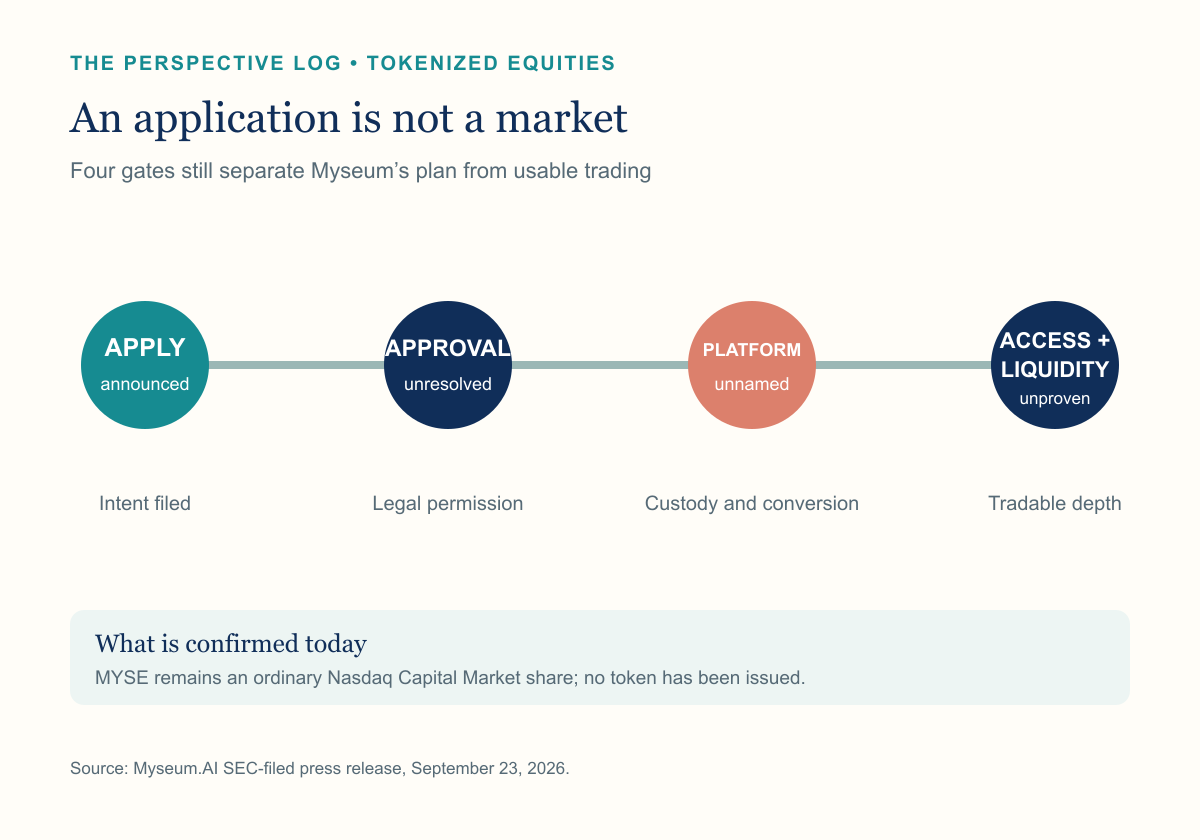
Myseum moved tokenization from an industry idea into a company-specific application plan. It did not announce approval, a launch date, a trading venue or a finished product.
The issuer-authorized structure matters because tokenized-equity markets can otherwise blur three very different things: a real share recorded through new infrastructure, a receipt or claim backed by shares held elsewhere, and a synthetic product that only tracks a stock’s price.
Myseum is promising the first category. If implemented as described, the digital unit would represent ownership of the same registered common stock and preserve the rights of traditional shareholders.
The filing sets hard boundaries. The announcement is not an offer to sell securities. Existing MYSE shares continue trading on Nasdaq. Any tokenized version would remain subject to securities law, platform requirements and geographic restrictions.
Why it matters
Tokenization is often sold as a technology upgrade. For investors, it is better understood as market plumbing with a legal wrapper.
The possible upside is meaningful. Myseum says blockchain records could expand access through digital-native platforms, make ownership records more transparent, improve settlement and transfers, and support extended or continuous trading where legally allowed.
But each benefit creates a matching question. Faster settlement is useful only if cash, custody and transfer agents synchronize with the token. Extended hours matter only if liquidity survives outside the main session. Global access remains constrained by securities law and platform eligibility. A transparent ledger does not, by itself, tell an investor who bears loss when a wallet, platform or smart contract fails.
For Myseum, the plan may attract attention disproportionate to the company’s size. That can improve visibility and potentially widen access. It can also turn the stock into a test of whether “tokenized” creates durable liquidity or only a second venue with a new label.
The case
The strongest argument is that the underlying asset does not need to change for distribution to improve.
Public equities already separate ownership, custody, execution, clearing and settlement across multiple institutions. A properly designed token can compress parts of that chain while leaving corporate rights intact. The token is then a new rail for an old asset, not a cryptocurrency substitute for a share.
Issuer authorization can reduce one major ambiguity. If the company, transfer agent and regulated platform agree on what the digital unit represents, investors have a clearer claim than they would with an unaffiliated synthetic tracker.
The model could also make small public companies easier to reach through platforms used by digital-asset investors. Myseum explicitly lists broader engagement with global and digitally native investors as a potential benefit.
The economic payoff, however, comes only after the legal and operational design works at market scale. Technology can make a ledger faster. It cannot manufacture market makers, investor demand or regulatory permission.
The other view
This may be marketing ahead of infrastructure.
Myseum has announced an intention to apply, not an approval. The filing does not identify a platform, a transfer agent arrangement, custody safeguards, interoperability standards, fees, minimum liquidity or a launch timetable.
A tokenized share can also fragment trading. If the same economic interest trades in a conventional order book and on one or more digital platforms, prices and liquidity can diverge. Arbitrage may close the gap, but only if transfers are fast, legally certain and available to the same participants.
Continuous trading is not automatically better trading. Thin overnight books can widen spreads and make price moves easier to exaggerate. Retail access can expand at the same moment execution quality deteriorates.
The conservative interpretation is therefore simple: this is a useful experiment, but not yet a new market. The company’s own caveats say the same thing.
What to watch next
- Which qualified digital-asset securities platform Myseum chooses, and whether that platform can legally serve U.S. retail investors.
- Whether the token is recorded directly on the shareholder register or represents an interest held through an intermediary.
- How creation, redemption, custody and recovery work when tokens or credentials are lost.
- Whether conventional MYSE shares and the tokenized representation are freely convertible without introducing settlement delays or fees.
- Whether real market makers commit capital and keep spreads tight outside normal Nasdaq hours.
- What approval is required before launch and which regulator or self-regulatory organization provides it.
Decision in 30 seconds
Myseum’s proposal is more credible than a synthetic token because the company says it would represent actual registered common stock and preserve voting and economic rights.
It is also much earlier than the headline suggests. No token has been issued. Nasdaq trading is unchanged. Approval, platform design, legal access and liquidity are all unresolved.
The investment question is not whether blockchain can display a share. It is whether a regulated market can keep one share, one ownership record and one set of rights intact across two trading rails. Until Myseum identifies the infrastructure and clears those gates, this is a plan—not a product.
Primary sources
- Myseum.AI SEC-filed press release, September 23, 2026
