
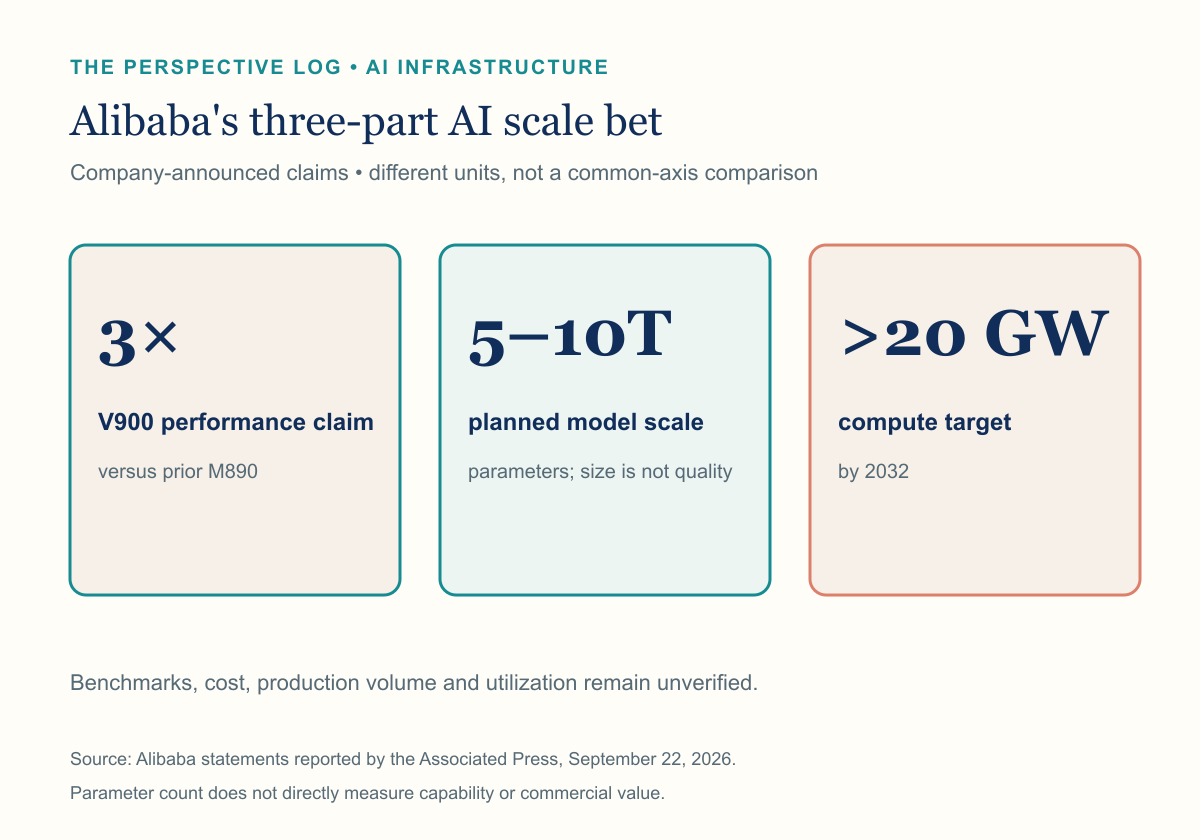
Alibaba has put three large numbers into one strategy. The company says its new Zhenwu V900 AI chip delivers three times the performance of its previous Zhenwu M890. It plans to train a model with five to 10 trillion parameters. And it expects to have more than 20 gigawatts of computing capacity by 2032.

The chip claim will attract the attention. The capacity target is the harder investment test. Alibaba is not merely presenting another component; it is arguing that a Chinese cloud company can design more of its own compute stack, train much larger models and build enough infrastructure to serve customers despite U.S.-led technology restrictions and global supply constraints.
What changed
The Associated Press reported the announcement on September 22. At Alibaba’s annual conference in Hangzhou, CEO Eddie Wu described the Zhenwu V900 as the most powerful AI chip in China today. He said it provides three times the performance of the prior M890. Those are company claims reported by the Associated Press, not results from a public independent benchmark.
Alibaba also outlined a next-generation model at five to 10 trillion parameters. Its latest Qwen3.8-Max has 2.4 trillion parameters, according to AP. A larger parameter count can increase capacity, but it does not by itself prove better answers, lower cost or stronger revenue.
The physical ambition is larger still. Alibaba says it expects to exceed 20 gigawatts of computing capacity by 2032. Wu also acknowledged that shortages across the AI data-center supply chain are already limiting how quickly the company can expand.
Why it matters
Alibaba is trying to own more of the stack
Cloud economics change when the provider controls the chip, the model and the data center. In theory, tighter integration can reduce reliance on scarce outside accelerators, tune hardware to internal workloads and give cloud customers a more predictable supply of computing power.
That matters because advanced Nvidia products remain restricted in China and because frontier AI training consumes enormous quantities of chips, networking equipment, cooling hardware and electricity. A credible domestic alternative could strengthen Alibaba Cloud inside China and give the company another way to compete on availability and cost.
But ownership also concentrates execution risk. Alibaba must turn a chip announcement into reliable volume production, software support and customer deployments. It must secure power and equipment for the 20-gigawatt target. A bottleneck at any layer can weaken the economics of the whole stack.
The missing number is the price
Alibaba did not provide a complete capital-spending figure for the buildout in the AP report. That omission matters. Twenty gigawatts describes an infrastructure scale, not its return on capital. Investors still need to know how quickly customers use the capacity, what they pay, how much power and cooling cost, and whether the V900 lowers the cost of each useful AI response.
The same caution applies to the three-times performance claim. Without workload definitions, power consumption, software conditions and independent testing, it cannot be converted into a market-share forecast. The claim creates a benchmark to verify; it does not settle the race.
The case
The bullish case is vertical integration under constraint. Alibaba already operates a major cloud platform and develops the Qwen model family. A competitive in-house accelerator could make those assets reinforce one another: cloud demand justifies chip investment, custom chips support larger models, and stronger models attract more cloud usage.
The 20-gigawatt target also signals that management expects AI demand to remain structurally high through 2032. If utilization grows with capacity, the buildout could deepen Alibaba’s position in Chinese enterprise computing and reduce exposure to restricted foreign hardware.
The other view
Announcements are not deployments. Semiconductor performance depends on manufacturing yields, memory, networking, software and power efficiency as much as chip design. China’s foundry constraints may limit how quickly Alibaba can produce advanced accelerators at scale.
The model target also risks becoming an expensive vanity metric. Parameters are not profits. Smaller or more efficient systems can sometimes deliver better economics for real customer workloads. A five-to-10-trillion-parameter model is valuable only if capability, reliability and paid demand rise faster than the cost of training and serving it.
Finally, 20 gigawatts creates an energy and capital obligation. Supply-chain shortages are already slowing expansion, by Wu’s own account. The gap between announced capacity and usable, economical capacity may determine whether this becomes an advantage or an expensive bottleneck.
What to watch next
First, look for independent V900 benchmarks that disclose workload, precision, power draw and comparison conditions. “Three times” becomes decision-useful only when the denominator is clear.
Second, watch for foundry, memory and networking evidence that indicates production volume rather than a conference-stage chip. Customer availability and pricing will say more than a peak-performance claim.
Third, track Alibaba’s capital expenditure and cloud revenue against the path to 20 gigawatts. Rising capacity without rising utilization would pressure returns. Capacity that fills at improving unit economics would validate the integrated strategy.
Fourth, separate model size from model usefulness. Independent evaluations, enterprise adoption and inference cost will show whether the planned parameter leap produces commercial value.
Decision in 30 seconds
Alibaba’s announcement is not one product story. It is a claim that domestic chips, much larger models and a more-than-20-gigawatt compute estate can operate as one competitive system. The V900’s stated three-times performance is unverified, and the company has not supplied the cost or return profile of the buildout. Treat the announcement as a measurable execution challenge: benchmarks, production availability, utilization and cloud revenue now have to catch up with the scale of the promise.
Jasper Kellan is editor of The Perspective Log. This article is general information, not personal investment, tax or legal advice. Published September 23, 2026.
Primary sources
- Associated Press — Alibaba unveils new AI chip and model plans
