
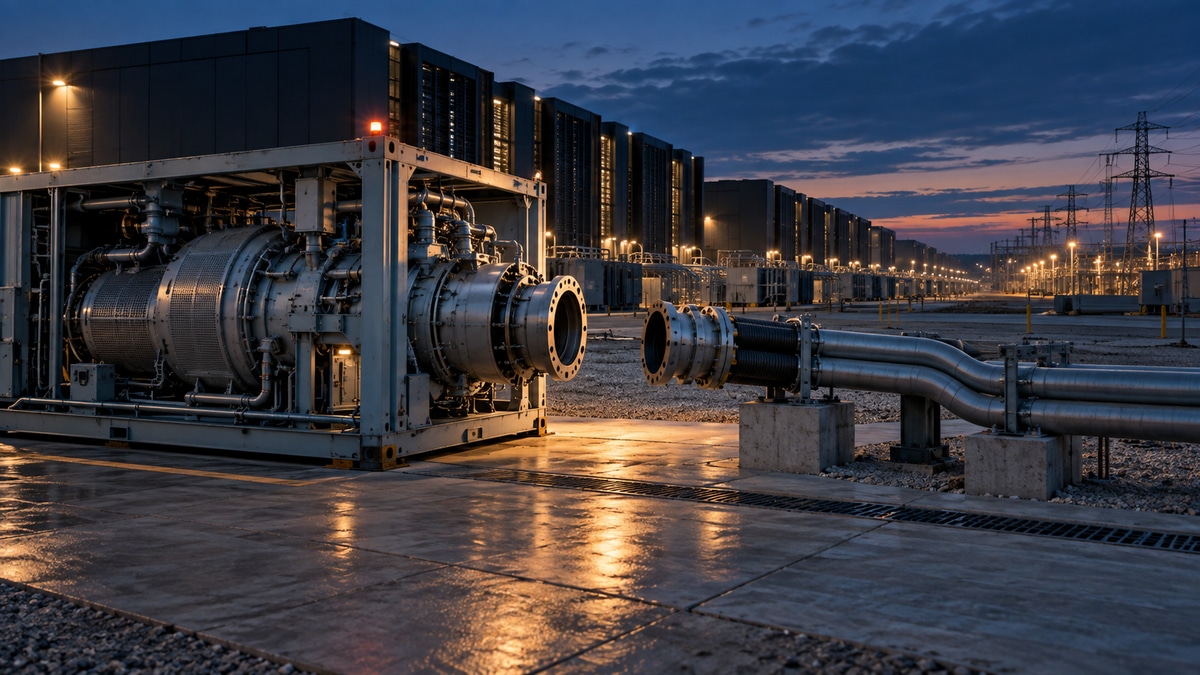
Boom Supersonic had an elegant bridge between two expensive ambitions. Sell a ground-based version of its jet engine to power AI data centers, use the revenue and operating data to mature the engine, then carry the same core into a supersonic airliner. Crusoe’s $1.25 billion order was meant to prove that bridge could hold.

Now the launch customer has walked away before the first turbine shipped. The breakup is bigger than one supplier change. It is a warning about the most crowded trade in AI infrastructure: promising power quickly is easy; delivering a permitted, financed and operational power plant on a data-center schedule is not.
What changed
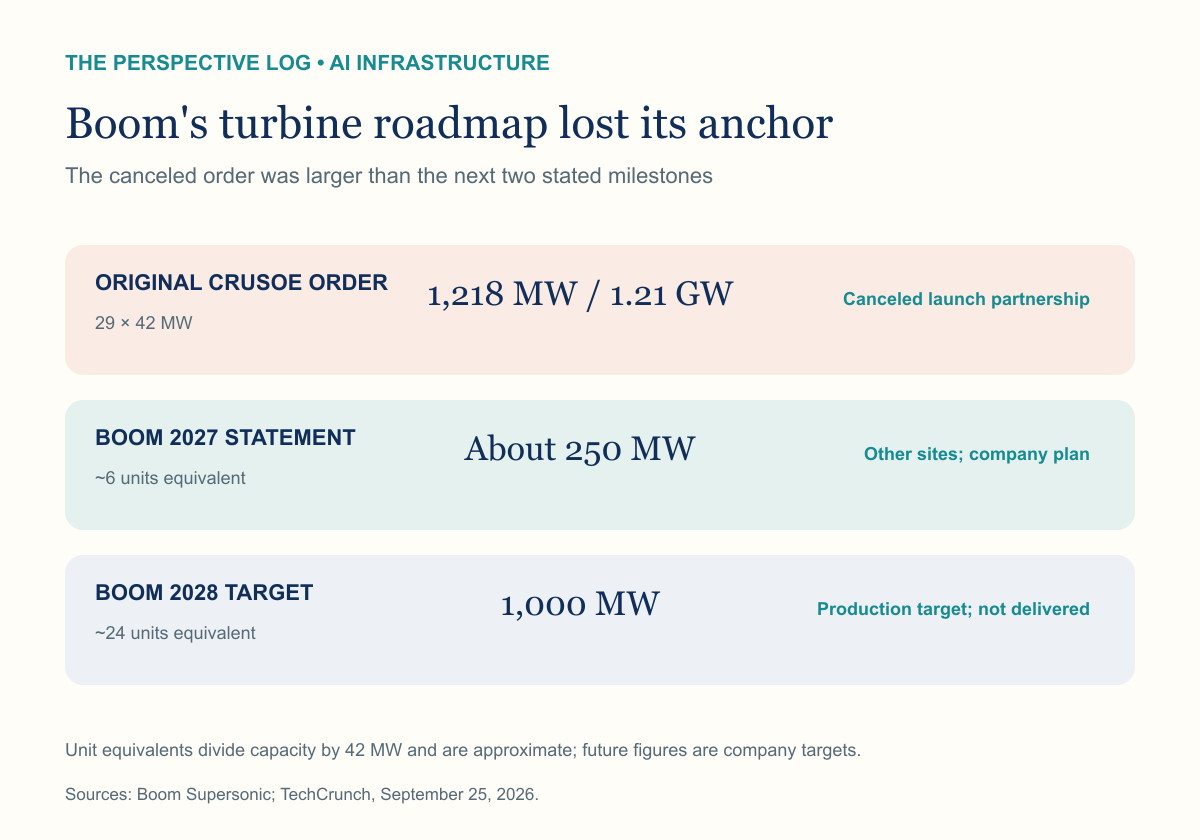
On September 25, TechCrunch reported that Crusoe and Boom are no longer moving forward with their Superpower launch partnership. Boom CEO Blake Scholl said the company expects to deliver roughly 250 megawatts to other sites next year and is targeting one gigawatt in 2028. Crusoe spokesperson Andrew Schmitt said the company’s energy plans have not changed and that it still intends to use turbines, “just not Boom’s.”
The original December 2025 announcement was substantial. Crusoe ordered 29 Superpower units rated at 42 megawatts each. That is 1,218 megawatts of nameplate capacity, which Boom presented as 1.21 gigawatts, with an order value above $1.25 billion and first deliveries planned for 2027.
Boom designed Superpower around the same engine core as Symphony, the engine intended for its Overture airliner. The company said the stationary turbine and aircraft engine would share about 80% of their parts. It also raised $300 million and said revenue from the power business would help finance Overture’s certification and delivery.
That made Crusoe more than a buyer. It was the first commercial proof point for a business model linking AI’s electricity shortage to a supersonic-aircraft program. Boom still says it has other customers in its pipeline. The disclosed launch order, however, is gone.
Why it matters
AI developers are racing to secure chips, land and electricity at the same time. Turbines look attractive because they can put generation beside the servers and reduce dependence on a congested grid connection. But a turbine announcement is not a power plant. The equipment still needs fuel, emissions controls, interconnection, construction, permits and a buyer willing to accept execution risk.
The Crusoe reversal shows why the bottleneck cannot be measured only in announced megawatts. The original 1.21-gigawatt figure described 29 machines in an order, not operating capacity. Boom’s new 250-megawatt and one-gigawatt figures describe future targets for other sites, not replacement revenue already demonstrated in the report.
For Boom, the loss reaches beyond power equipment. Superpower was supposed to create a second route to cash and generate operating evidence for an engine architecture shared with Overture. If other buyers do not replace Crusoe on similar economics and timing, the funding bridge to the aircraft program becomes less certain.
For data-center developers, the event reinforces a harder rule: power technology must fit the site, not the story. Crusoe says it remains open to turbines and is using different power mixes across projects. Its initial 1.2-gigawatt Abilene campus for Oracle and OpenAI is grid-powered, with gas turbines serving as backup. A separate 900-megawatt project for Microsoft is planned around on-site gas turbines. The same developer can make different choices because grid access, construction timing and site economics differ.
The case
Boom’s idea still has industrial logic. A 42-megawatt package is large enough to matter to a data-center campus but modular enough to deploy in stages. Boom says the turbine maintains rated output above 110°F and operates without water, both useful attributes in hot, water-constrained markets where AI campuses are expanding.
The shared engine core could also create a learning loop. Stationary turbines can accumulate operating hours and reveal maintenance patterns before the aviation version enters passenger service. More production volume can spread engineering and supplier costs across two markets rather than one.
Demand for fast power is real. Grid queues and equipment lead times are pushing hyperscalers and developers toward on-site generation, batteries and hybrid systems. A new entrant does not need to displace the entire turbine market. It needs a few credible projects, reliable delivery and performance that compensates buyers for choosing an unproven supplier.
Boom’s revised targets leave that possibility open. Delivering approximately 250 megawatts in 2027 would imply roughly six 42-megawatt units. Reaching one gigawatt in 2028 would require a much larger production step. Those milestones are now the test.
The other view
One canceled launch partnership does not prove the turbine is technically flawed or commercially dead. Neither company publicly attributed the split to performance, price or a failed test. Crusoe described the decision as a question of fit and flexibility, and Boom says other customers remain in its pipeline.
The original deal may also have become less central as Crusoe’s portfolio changed. An energy-first developer can switch vendors or power architectures as sites, customers and schedules evolve. That is normal procurement discipline, not necessarily a verdict on the product.
But the burden of proof has moved. Boom’s December announcement linked a named customer, a dollar value, a capacity figure and a delivery year. The replacement case currently rests on management statements about other sites and future production. Investors and partners should not treat a target as equivalent to the lost order.
There is a second tension. Simple-cycle gas turbines can be deployed faster than some grid upgrades, but speed can come with lower fuel efficiency and local emissions. The all-in project cost also extends well beyond the turbine package. A product can solve the equipment shortage while failing the economics, permitting or community-acceptance test at a specific site.
What to watch next
First, watch for named replacement customers, binding order values and deposits. “Pipeline” becomes evidence only when a buyer, site and commercial commitment are disclosed.
Second, watch the 2027 delivery claim. Approximately 250 megawatts is a concrete checkpoint. Factory progress, completed engine-core tests and units installed at identifiable sites will matter more than another capacity target.
Third, watch Crusoe’s alternative turbine suppliers. The replacement choice will show whether the split was specific to Boom or reflects a broader shift in the economics and timetable of on-site gas generation.
Finally, watch whether Superpower continues to finance Overture as originally described. If the stationary business scales later or more slowly, Boom may need another source of capital for the aircraft program.
Decision in 30 seconds
For AI-infrastructure investors: Discount announced megawatts until equipment, site, fuel, permits and financing line up. The cancellation turns Boom’s delivery record and named replacement customers into the key evidence.
For data-center developers: Treat power as a portfolio of site-specific options. Compare the full installed cost and schedule, not only the turbine price or rated output, and keep a credible fallback before making a new supplier critical path.
For Boom and its partners: The fastest way to repair confidence is operational proof: a tested engine core, a disclosed replacement order and the first delivered unit. A bigger long-term target will not substitute for those steps.
Primary sources
- Boom Supersonic: original Superpower launch, Crusoe order and $300 million financing
- TechCrunch: on-record confirmation that Crusoe and Boom ended the launch partnership
- TechCrunch: original transaction economics and turbine-cost context
Boom’s production, delivery and performance figures are company claims. The companies have not disclosed detailed termination terms or a definitive cause for the split. This analysis is informational and is not investment advice.
