

The Federal Reserve enters today’s decision with its federal-funds target range at 3.50%–3.75%. Markets broadly expect a quarter-point increase, but the decision has not been announced as this article is published.

That distinction matters. A forecast is not a rate change, and a Fed move is not a promise that every mortgage, savings account or credit card will move by the same amount. The useful first step is smaller: translate 0.25 percentage point into dollars.
What changed
The FOMC is completing its September 15–16 meeting today. This meeting also includes a new Summary of Economic Projections, so investors will receive both a policy decision and an updated view of where committee participants think inflation, employment, growth and rates may go.
At its July 29 meeting, the committee held the target range at 3.50%–3.75% by a 9–3 vote. Three members preferred a quarter-point increase. The statement said inflation remained elevated relative to the Fed’s 2% goal and cited supply shocks, including energy.
The Associated Press reported Tuesday that markets broadly expected a quarter-point increase today. That expectation is newsworthy, not definitive. The official FOMC statement is the result that matters.
Why it matters
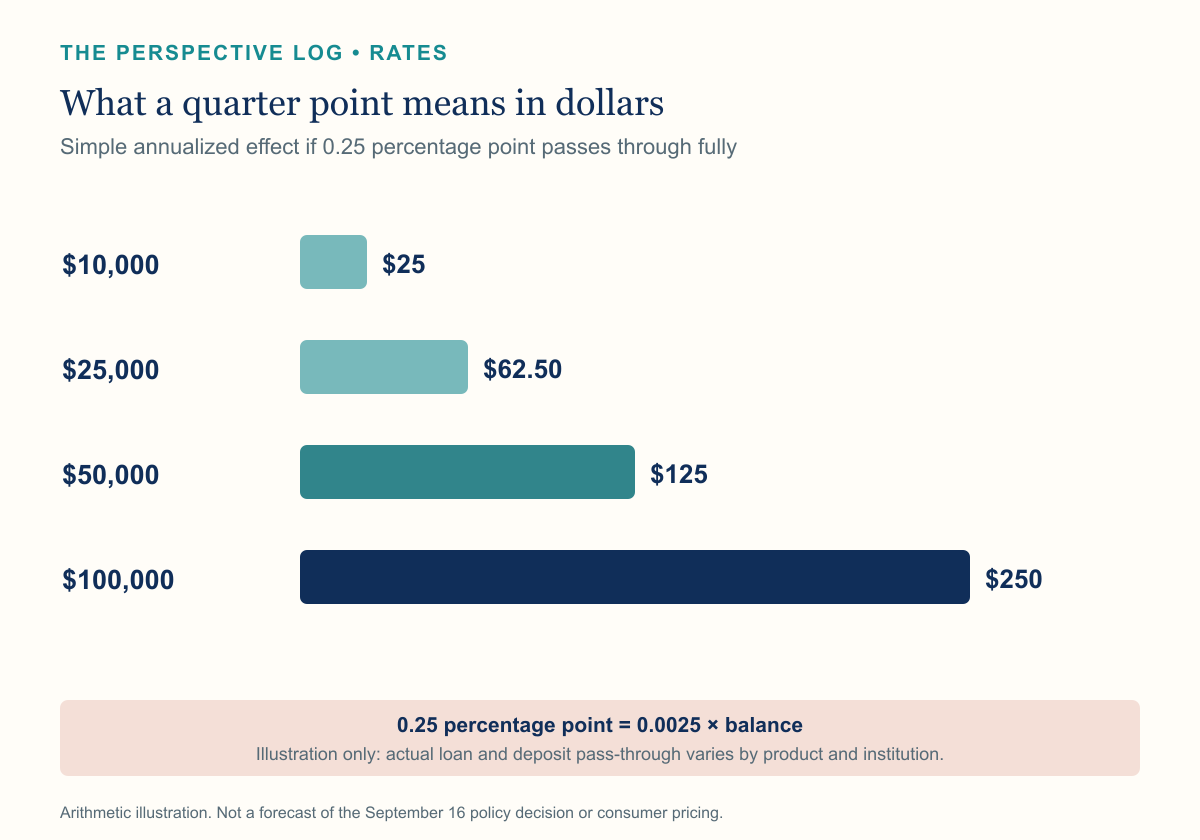
A quarter point sounds tiny because it is written as 0.25%. In dollar terms, it equals $25 a year for every $10,000 of balance when applied fully for a full year.
The scale grows with the balance: $62.50 on $25,000, $125 on $50,000 and $250 on $100,000. Those are simple annualized comparisons, not predicted changes to a particular account or loan.
For borrowers, the policy rate is an upstream price. Variable credit products can reprice quickly, but contract terms, lender margins and timing decide the actual change. Fixed-rate mortgages already issued do not reset because the Fed moves.
For savers, the direction can be favorable while the pass-through remains uneven. Banks choose deposit rates. A higher policy range does not require an institution to add the full quarter point to a savings account.
The case
The cleanest use of today’s decision is to audit exposure, not trade the headline.
Start with variable-rate debt. Find the index, margin, reset date and any cap in the agreement. A $10,000 balance that actually reprices by 0.25 percentage point carries roughly $25 more annual interest before payments and compounding effects. A larger move by the lender would produce a different result.
Next, separate fixed borrowing from future borrowing. An existing fixed mortgage payment does not change with today’s decision. A new mortgage quote can move for many reasons because longer-term Treasury yields, inflation expectations, credit risk, fees and competition all matter.
Then compare cash yields after the decision. Record the annual percentage yield on each meaningful cash balance. If an institution keeps its rate unchanged while competitors adjust, the relevant household question is whether the after-tax difference justifies moving the money.
Finally, avoid treating the Fed’s projections as promises. The dots summarize individual participants’ assessments under uncertainty. They are not a committee commitment to a schedule.
The other view
One quarter point may not justify any action. On a modest balance, the annual dollar difference can be smaller than a transfer fee, an account restriction or the value of keeping a simple system.
Markets may also react in a direction that appears inconsistent with the decision. A rate increase intended to reinforce inflation credibility could leave some longer-term yields stable or lower. A hold that surprises investors could push longer yields higher. The policy rate and the mortgage market are connected, not identical.
The same caution applies to stocks. A single move can change discount rates at the margin, but earnings, energy costs, AI capital spending and the path of future policy may matter more than today’s quarter point.
What to watch next
Read the official statement first. Confirm the new target range, the vote and any change in the committee’s description of inflation, employment and economic activity.
Then compare the new projections with June’s set, especially the median policy-rate path and the inflation outlook. Listen for whether Chair Kevin Warsh frames the decision as the start of a sequence, a one-time risk-management move or a response dependent on incoming data.
Over the following days, watch actual prices available to you: savings APYs, Treasury-bill yields, credit-card notices, home-equity lines and fresh mortgage quotes. Those are the transmission channels that turn policy into household math.
Decision in 30 seconds
Before the September decision, the federal-funds target range is 3.50%–3.75%. A full quarter-point change equals $25 a year per $10,000 of balance, but consumer rates do not move mechanically or uniformly. Identify variable debt, compare cash yields after institutions update them, and do not refinance or reposition a portfolio on the policy headline alone.
Primary sources
- Federal Reserve Board, FOMC meeting calendar
- Federal Reserve Board, July 29, 2026 FOMC statement
- Associated Press, September 15, 2026 policy preview
This article is general information, not individualized investment, borrowing or banking advice. Rates, product terms and market prices can change.
