
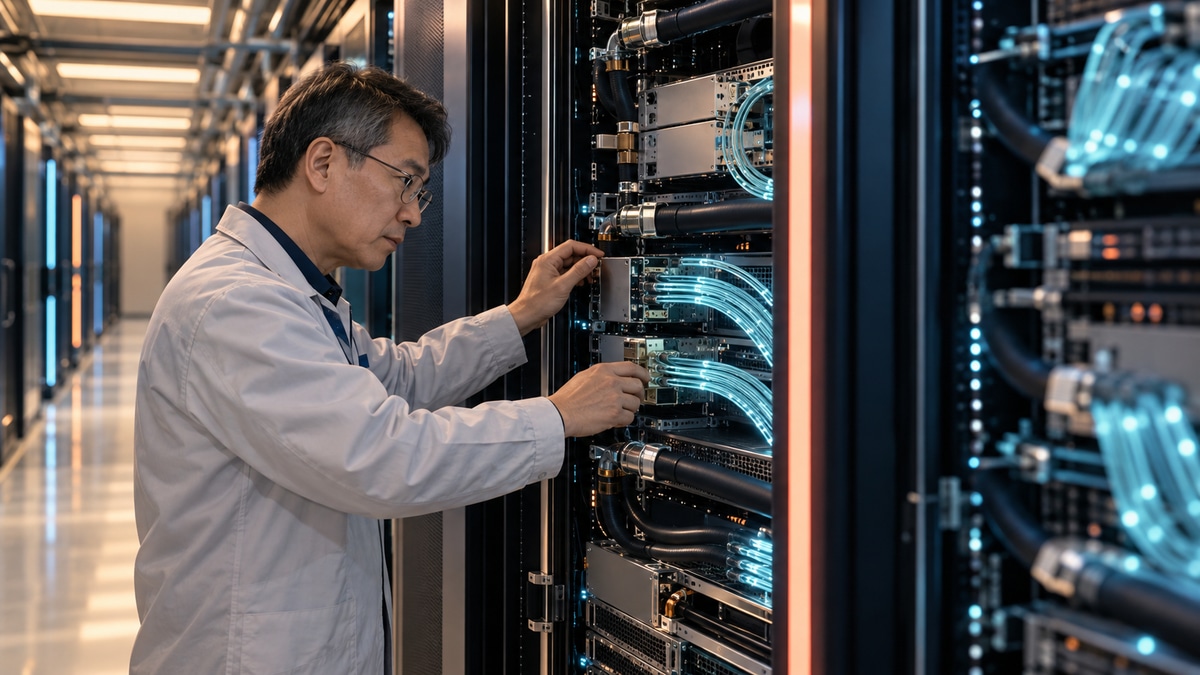
Huawei’s newest AI machine makes a blunt argument about the next phase of the chip race: the winning product may be the system that wastes less power moving data, not simply the processor with the strongest headline specification.

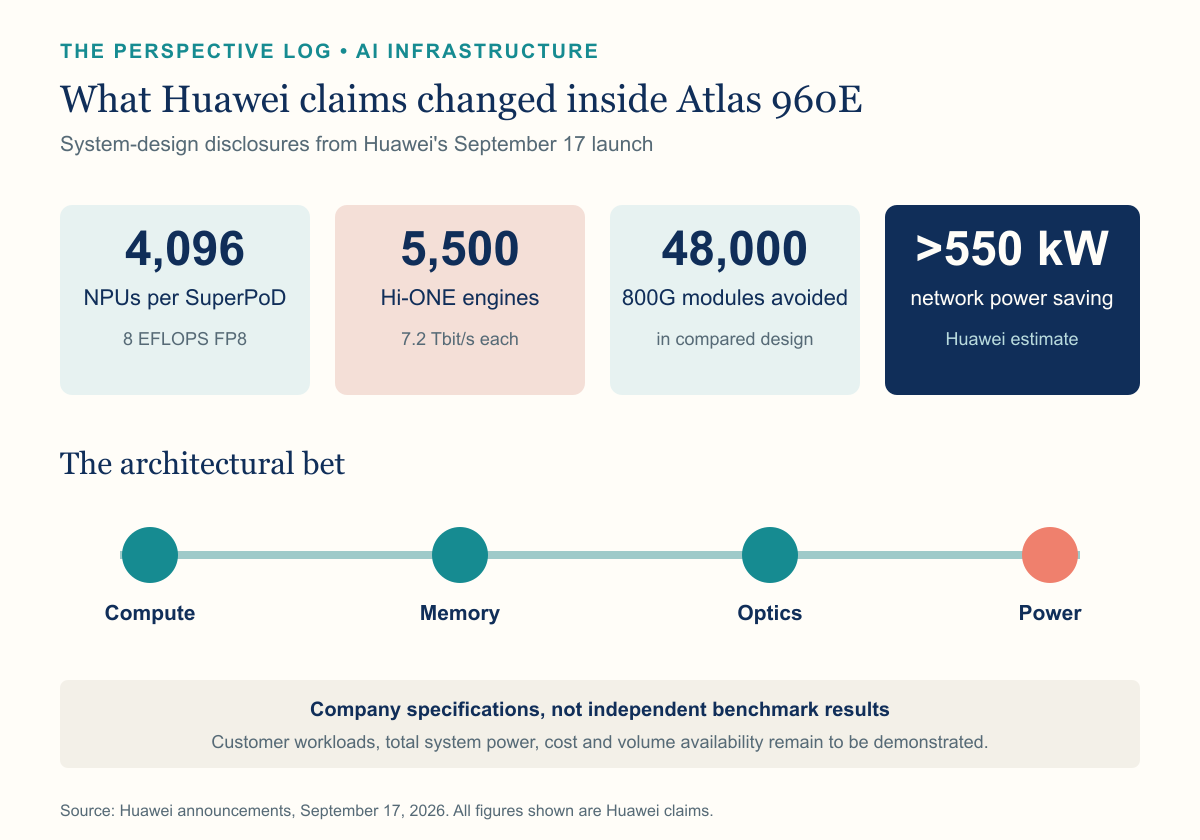
At HUAWEI CONNECT in Shanghai on September 17, Huawei unveiled the Atlas 960E SuperPoD, a liquid-cooled system built around its forthcoming Ascend 960 processors and a near-packaged optical interconnect called Hi-ONE. The company says a single SuperPoD can connect 4,096 neural processing units, deliver 8 EFLOPS at FP8 precision and hold as much as 1 petabyte of high-bandwidth memory.
The number worth watching is 550 kilowatts. Huawei says 5,500 Hi-ONE optical engines allow the system to avoid 48,000 conventional 800G optical modules and reduce network power consumption by more than 550 kW. That is a company claim, not an independently audited benchmark. But it identifies where AI infrastructure competition is moving: from the chip alone to the power, memory, cooling and interconnect architecture around it.
What changed
Huawei did not announce only another accelerator. It presented an integrated computing design intended to make thousands of processors behave like one large machine. The Atlas 960E uses Huawei’s UnifiedBus protocol and Hi-ONE near-packaged optics to link compute, memory and networking more tightly than a conventional rack-by-rack cluster.
Huawei says each Hi-ONE engine carries 7.2 terabits per second and includes its own light source. In the Atlas 960E, 5,500 of those engines are meant to do work that would otherwise require 48,000 pluggable 800G optical modules. The company also claims 99.8% system availability and twice the fault-free operating time of the compared design.
The roadmap moved forward too. Huawei says the Ascend 960DT will be available in the first quarter of 2027, three quarters earlier than its original plan, while the 960PR is scheduled for the third quarter of 2027. Multiple SuperPoDs could be connected into a SuperCluster with as many as 512,000 NPUs, and Huawei says a multi-rail topology could scale to one million.
Those dates and capacities are forward-looking company statements. A design that can theoretically scale is not the same thing as a fully deployed cluster, and availability is not the same thing as volume shipments to customers.
Why it matters
The AI investment debate often compresses the entire infrastructure stack into one question: who has the fastest accelerator? That framing is becoming incomplete.
Large AI models spend meaningful time and energy moving data among processors. Huawei says communications can consume more than 40% of total training time in a conventional 100,000-NPU cluster. Faster processors do not solve that bottleneck if memory and networking cannot feed them efficiently.
Power is the second constraint. A claimed 550-kW network saving is material at the equipment level, but it should not be confused with the electricity use of an entire data center. The full facility still has to power processors, memory, storage, cooling, pumps and supporting infrastructure. Huawei has not published an independently verified total-cost comparison that would let investors translate the figure into a customer payback period.
The strategic consequence is still important. U.S. export restrictions have limited China’s access to the most advanced AI chips and manufacturing equipment. Huawei is responding by trying to extract more useful system performance from components and process technology available to it. The Associated Press described the launch as another step in China’s push for semiconductor self-reliance.
The case
If Huawei’s architecture performs as advertised, it strengthens three investment themes.
First, AI networking is moving closer to the processor. Near-packaged and co-packaged optics can reduce the distance electrical signals travel and lower the number of separate modules. That raises the strategic value of optical engines, lasers, high-speed switching and advanced packaging alongside accelerators.
Second, infrastructure efficiency becomes a source of compute supply. Saving power in the network does not create a new power plant, but it can free capacity inside a constrained data-center power envelope. For operators waiting years for a larger grid connection, every kilowatt that does not go to interconnect overhead can potentially support more productive compute.
Third, export controls may redirect innovation rather than stop it. Restrictions can slow access to leading manufacturing nodes, yet they also reward architectural workarounds: larger systems, tighter interconnects, custom data formats and software designed around domestic hardware. That does not prove Huawei has matched Nvidia’s usable performance, software breadth or economics. It means investors should not treat semiconductor competition as a simple transistor-count contest.
For listed companies, the implications reach beyond the two best-known accelerator vendors. The Atlas 960E highlights demand for high-bandwidth memory, liquid cooling, optical components, power distribution and data-center construction. It also raises a harder question for suppliers: which technologies become more valuable when customers redesign the whole system, and which modular products get engineered out?
The other view
Huawei’s launch is rich in specifications and sparse in independent evidence. The company controls the workload assumptions, comparison architecture and definitions behind its performance and reliability claims. There are no third-party training results, customer total-cost disclosures or broad production data in the announcement.
Software remains another hurdle. Nvidia’s advantage is not only silicon; it includes a mature developer ecosystem, libraries and tools. Huawei says its CANN software is moving to sustained open-source development and that Ascend is supported as a PyTorch accelerator backend. Openness can reduce switching costs, but it does not instantly reproduce years of optimized software and developer familiarity.
There is also a trade-off between integration and flexibility. A tightly coupled system can improve efficiency, but it can make customers more dependent on one vendor’s processors, interconnect, memory architecture and software stack. A claimed reduction in pluggable modules may be good for the operator and challenging for suppliers whose economics rely on those modules remaining discrete.
Finally, the roadmap risk is real. Ascend 960 products are scheduled for 2027. Manufacturing yield, memory supply, optical-engine production and deployment reliability will determine whether the promised system becomes a commercial alternative or remains an impressive conference design.
What to watch next
Watch for three kinds of evidence.
The first is deployment evidence: named customers, installed systems and measured utilization rather than maximum supported scale. A one-million-NPU topology matters only if the network, software and failure management work under sustained production loads.
The second is comparable efficiency data. Investors need total system power, training throughput, inference cost and uptime measured on disclosed workloads. The 550-kW claim is useful, but it covers the network comparison Huawei chose; it does not settle the broader economics.
The third is supply-chain follow-through. Huawei’s Q1 and Q3 2027 chip dates create checkpoints for production, memory availability and optical packaging. Delays would weaken the roadmap. On-time shipments with credible customer benchmarks would make the competitive threat harder to dismiss.
Decision in 30 seconds
Do not read Huawei’s announcement as proof that it has overtaken Nvidia. Read it as evidence that the AI infrastructure race is broadening.
The Atlas 960E puts optical networking, power efficiency, memory and system design on the same strategic level as the accelerator. Huawei’s 550-kW saving, 4,096-NPU scale and 99.8% availability are company claims awaiting independent validation. Yet the direction is credible: constrained power and communications overhead are forcing the industry to compete on whole-system efficiency.
For investors, the practical move is to track the enabling stack—not just the flagship chip—and demand comparable customer data before turning architectural promises into earnings assumptions.
Primary sources
- Huawei: Atlas 960E SuperPoD announcement, September 17, 2026
- Huawei: David Wang keynote and Ascend roadmap, September 17, 2026
- Associated Press: Huawei unveils new chip technologies, September 17, 2026
