

The average 30-year fixed mortgage rate reached 6.76% on September 10, according to Freddie Mac. At that level, a small-looking difference between two lender offers can become a durable household expense.

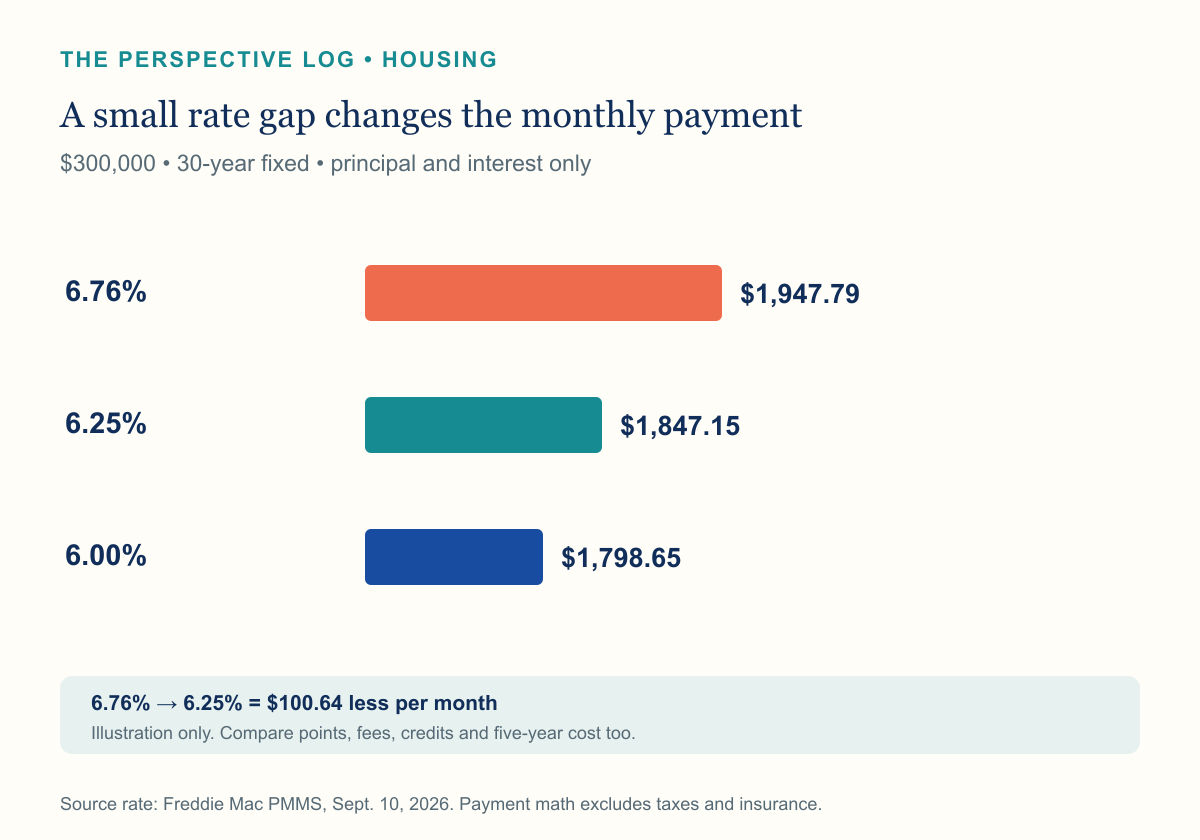
On a $300,000 30-year loan, principal and interest would be about $1,948 a month at 6.76%. At 6.25%, the same calculation is about $1,847. The gap is $100.64 a month before taxes, insurance, mortgage insurance, points or fees.
That does not mean 6.25% is available to every borrower. It means the payoff from collecting comparable offers is large enough to measure before choosing a lender.
What changed
Freddie Mac’s latest Primary Mortgage Market Survey put the 30-year fixed average at 6.76%, up from 6.71% a week earlier. The 15-year fixed average was 6.09%, up from 6.04%.
A year ago, the corresponding averages were 6.35% and 5.50%. Borrowing has become more expensive across both common fixed terms, although a national average is not a personal quote.
The survey reflects conventional, conforming home-purchase applications submitted through Freddie Mac’s Loan Product Advisor from the prior Thursday through Wednesday. It does not publish average points and fees. Your credit profile, down payment, property, loan type, points and lender pricing can produce a different offer.
Why it matters
Many buyers negotiate the house price aggressively, then treat the mortgage rate as a market fact. The market sets the backdrop; the lender still sets the offer.
The Consumer Financial Protection Bureau tells borrowers to request Loan Estimates from multiple lenders and compare more than the rate. The monthly principal-and-interest payment matters, but so do origination charges, lender credits, mortgage insurance, cash to close and total monthly payment.
For buyers over 40, the term deserves equal attention. A 30-year loan taken at 55 extends past age 80. That does not automatically make it a bad loan, but it puts the payment inside the retirement-income plan rather than outside it.
The case
Consider three fixed rates on the same $300,000 balance and 30-year schedule. The monthly principal-and-interest payment is about $1,947.79 at 6.76%, $1,847.15 at 6.25% and $1,798.65 at 6.00%.
The first comparison is the useful one. A 0.51-point reduction from 6.76% to 6.25% lowers the monthly payment by $100.64. Across 60 payments, the cash-flow difference is $6,038.40 before accounting for upfront costs or the different remaining balances.
If both loans stayed in place for all 360 payments, the lower rate would reduce total interest by $36,229.41. That full-term number is mathematically correct and behaviorally fragile: many borrowers sell, refinance or pay ahead long before year 30.
The five-year comparison is more practical. CFPB directs borrowers to page 3 of each standardized Loan Estimate, where the “In 5 years” line shows total paid and principal paid. Subtracting the second from the first gives the five-year interest-and-fee cost.
Use that figure to test whether a lower advertised rate is truly cheaper. A lender can reduce the rate by charging points, or offer credits in exchange for a higher rate. The monthly payment alone will not tell you when the upfront tradeoff breaks even.
The clean comparison has four rules:
- Ask each lender for the same loan amount, term, rate type and down-payment assumption.
- Gather estimates in a short window because market rates can change daily.
- Compare lender-controlled costs, not taxes and insurance that should be broadly similar.
- Calculate how long you expect to keep the loan before paying points for a lower rate.
The other view
The cheapest offer on paper is not always the safest closing. CFPB also lists the loan officer’s responsiveness and the lender’s ability to meet the closing timetable as valid considerations. A delayed closing can carry costs that the rate comparison does not capture.
There is also a tax argument for tolerating a higher mortgage rate: deductible interest can reduce the after-tax cost of borrowing. But the deduction is not automatic. IRS Publication 936 says taxpayers generally must itemize, the loan must be secured by a qualified home, and debt limits and use-of-proceeds rules can apply.
Do not reduce a 6.76% mortgage rate by a marginal tax bracket unless your own return actually produces that deduction. Even then, compare after-tax costs with a tax professional rather than treating the deduction as a rebate on every dollar of interest.
Finally, a shorter term can cut lifetime interest while raising the required monthly payment. The latest 15-year average was 6.09%, but a lower rate does not make the larger amortization payment comfortable. Retirement contributions, emergency reserves and health costs still need room in the budget.
What to watch next
Freddie Mac’s next regular weekly release is expected Thursday, September 17 at noon Eastern. That update can move the national reference point, but it will not replace borrower-specific quotes.
If you are shopping now, ask for at least two comparable Loan Estimates on the same day. Circle the interest rate, principal and interest, lender-controlled closing costs, lender credits, cash to close and the “In 5 years” numbers.
Then calculate the break-even period for any points. Divide the added upfront cost by the monthly payment savings. If the result is longer than you reasonably expect to keep the mortgage, the lower rate may not be the lower-cost offer.
Decision in 30 seconds
At the September 10 average of 6.76%, rate shopping is worth real effort. On a $300,000 30-year loan, 6.25% instead would lower principal and interest by about $101 a month. Collect comparable Loan Estimates in a short window, compare five-year interest and fees, and buy points only when the break-even period fits how long you expect to keep the loan.
Primary sources
- Freddie Mac, Primary Mortgage Market Survey — September 10, 2026
- Consumer Financial Protection Bureau, Choosing a loan offer
- Consumer Financial Protection Bureau, Compare and negotiate your loan offers
- Internal Revenue Service, Publication 936 (2025)
This article is general information, not individualized financial, tax, lending or investment advice. Mortgage offers and tax treatment depend on personal circumstances.
