

The 2027 Social Security cost-of-living adjustment now has two of its three inputs. July’s CPI-W index was 327.104 and August’s was 328.481. If September merely matches August, the statutory formula produces a 3.4% COLA after rounding.

That is useful planning information, but it is not an announcement. September can still move the number, and the Bureau of Labor Statistics will not publish that final input until October 14.
What changed
The August consumer-price report completed the second month of the third quarter. That matters because Social Security does not use the familiar annual CPI-U headline, and it does not use August’s 3.5% year-over-year CPI-W rate by itself.
The Social Security Administration compares the average CPI-W for July, August and September with the corresponding third-quarter average from the last year in which a COLA became effective. For the coming adjustment, the base is the third-quarter 2025 average of 317.265.
The first two 2026 readings are both above that base: 327.104 in July and 328.481 in August. They establish most of the arithmetic. September supplies the final third.
Why it matters
Household planning often starts before the official announcement. A retiree deciding how much cash to keep, whether a January expense fits, or how much can safely be withdrawn from savings needs a working range.
The two published readings make that range narrower than it was a month ago. They do not justify treating 3.4% as guaranteed.
For scale, a 3.4% adjustment on a $2,000 monthly gross benefit would add $68 a month, or $816 over 12 months. That is an arithmetic illustration. It is not the final COLA, and it does not predict a recipient’s net deposit after any deductions or taxes.
The case
The cleanest way to use the new data is to test several September outcomes rather than choose one forecast.
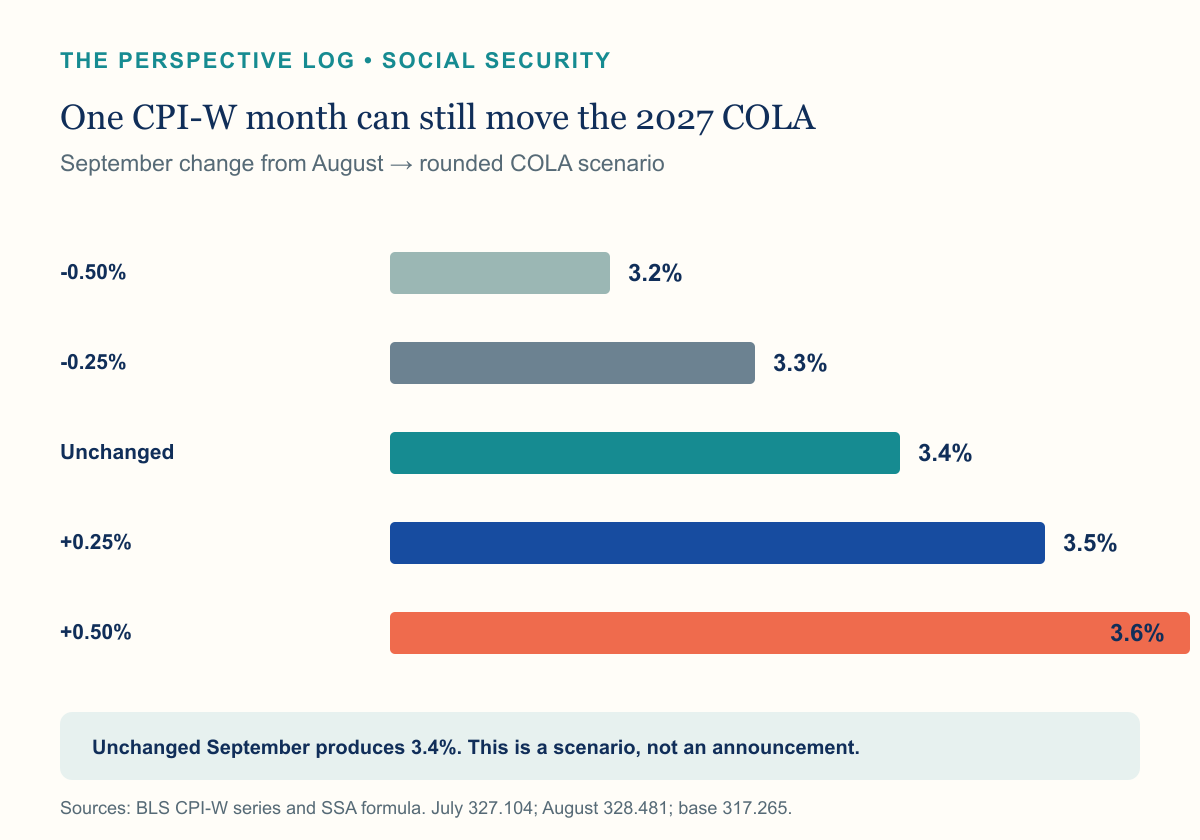
If September’s CPI-W is unchanged from August at 328.481, the three-month average would be 328.022. Compared with the 317.265 base, that is a 3.3905% increase, which rounds to a 3.4% COLA.
If September falls 0.25% from August, the implied index is 327.660. The formula rounds to 3.3%. A 0.50% decline produces 3.2%.
If September rises 0.25%, the implied index is 329.302 and the formula rounds to 3.5%. A 0.50% increase produces 3.6%.
These scenarios are deliberately mechanical. They show how much one remaining month can affect the result without pretending to know where prices will land.
For household decisions, that suggests three separate numbers:
- Use 3.2% as a conservative planning case from the displayed range.
- Use 3.4% as the unchanged-September middle scenario, not as promised income.
- Wait for the October 14 release before locking in spending that depends on the exact adjustment.
That approach also keeps a nominal benefit increase separate from purchasing power. A COLA is designed to respond to measured inflation. It does not mean a household is richer in real terms, and CPI-W does not mirror every retiree’s mix of housing, medical, food and energy costs.
The other view
One argument for waiting is straightforward: the official number is only a month away, so any interim calculation may create false precision.
That is fair for irreversible decisions. It is less useful for routine planning that already has to begin. A range can be more honest than either silence or a single-point forecast.
Another caution is that monthly CPI-W readings can move enough to change the rounded result. The chart spans a one-percentage-point band in September’s monthly change, from -0.50% to +0.50%. Across those scenarios, the rounded COLA ranges from 3.2% to 3.6%.
The lesson is not that either edge is likely. It is that the last observation still matters.
What to watch next
The next decisive date is Wednesday, October 14, when BLS is scheduled to release September consumer-price data at 8:30 a.m. Eastern.
Look for the unadjusted CPI-W index level, not only the CPI-U headline or a month-over-month percentage in news coverage. Once that index is available, the three-month average and rounded COLA can be calculated directly.
Then separate the published percentage from your own cash-flow result. Apply the official adjustment to your actual gross benefit, account for deductions and taxes that affect your situation, and compare the net change with the expenses that have moved most in your budget.
Decision in 30 seconds
Treat 3.4% as a useful middle scenario, not the 2027 COLA. For a $2,000 gross monthly benefit, it represents $68 a month before deductions or taxes. Keep a 3.2% to 3.6% range for near-term planning, and wait for the September CPI-W release on October 14 before committing the exact increase.
Primary sources
- Bureau of Labor Statistics CPI-W series, CWUR0000SA0
- Bureau of Labor Statistics, Consumer Price Index — August 2026
- Social Security Administration, latest COLA and calculation method
- Bureau of Labor Statistics, CPI release schedule
This article is general information, not individualized financial, tax or benefits advice.
