

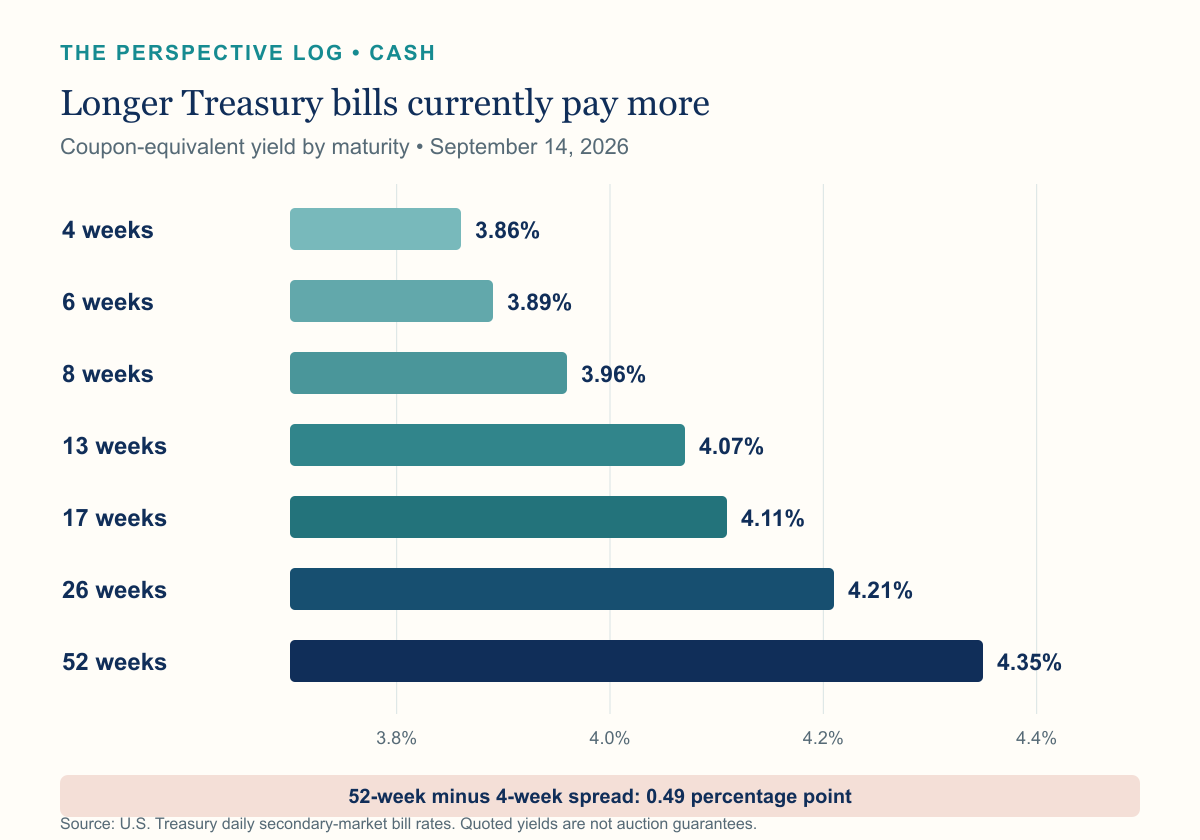
Cash is not paying one rate. On September 14, the Treasury’s coupon-equivalent yield was 3.86% for a four-week bill and 4.35% for a 52-week bill.

That 0.49-percentage-point gap is the market’s price for a very practical household choice: keep money available soon, or lock part of it away for nearly a year. With the Federal Reserve meeting September 15–16, the answer should come from your spending calendar, not a guess about tomorrow’s policy decision.
What changed
The Treasury-bill curve slopes upward across the regular maturities. Coupon-equivalent yields on September 14 were 3.86% for four weeks, 3.89% for six weeks, 3.96% for eight weeks, 4.07% for 13 weeks, 4.11% for 17 weeks, 4.21% for 26 weeks and 4.35% for 52 weeks.
These are secondary-market quotations on the most recently auctioned bills, collected at about 3:30 p.m. each business day. They are comparison rates, not a promise that a TreasuryDirect auction or brokerage order will execute at exactly the same yield.
The timing matters because the FOMC is meeting September 15–16, with new economic projections scheduled for this meeting. The article does not predict the decision. It treats today’s curve as a menu of current tradeoffs that can change after the meeting.
Why it matters
Many households keep every near-term dollar in the shortest instrument because it feels safest. Others reach for the highest displayed yield and overlook when the cash will be needed.
The first approach creates reinvestment risk. A four-week bill matures quickly, but its proceeds must be reinvested at whatever rate is available next month. The second approach creates a liquidity problem. A 52-week bill locks the maturity value until next year unless you sell it early at the market price.
For someone nearing retirement, those risks belong on different lines. Money for next month’s bills should not be treated like a one-year reserve. Money that genuinely will not be spent for a year does not necessarily need four-week liquidity.
The case
The 49-basis-point spread is meaningful but not transformative. On $50,000, 0.49 percentage point equals $245 on an annualized basis before federal tax.
That $245 is not a guaranteed extra return from choosing the 52-week bill. The four-week rate cannot be held for a full year without 12 future reinvestment decisions, and those future rates are unknown. The calculation simply measures the scale of today’s quoted yield difference.
A simple maturity ladder can separate the decision from the forecast. Match the first rung to known spending, keep an emergency layer immediately accessible, and place only money with a clear one-year horizon into the longest rung.
For example, a household with $50,000 beyond checking might divide it by purpose rather than evenly: immediate emergency cash, a four- or eight-week rung for a near expense, a 13- or 26-week rung for planned spending later in the year, and a 52-week rung only for money unlikely to be needed before maturity.
Treasury bills are sold at a discount or at par and pay face value at maturity. The regular terms run from four to 52 weeks, with a $100 minimum in TreasuryDirect. Interest is subject to federal tax but not state or local tax, which can affect comparisons with bank products for residents of higher-tax states.
The clean comparison has four questions:
- When is the earliest realistic date this money may be spent?
- How much must remain available without selling a security?
- Is the quoted figure a comparable investment yield, or a bank-discount rate?
- What is the after-tax result relative to an insured bank alternative available to you?
The other view
The shortest bill can still be the right choice even when its yield is lower. Flexibility has value if a roof, car, medical bill or family need could arrive before the longer security matures.
It can also be rational to wait through a policy event. Rates may move after the FOMC decision, and an investor who keeps maturities short gets another decision point quickly. The tradeoff is that the next rate could be lower, not higher.
Longer bills are marketable, so they are not literally inaccessible. But selling before maturity turns a known maturity payment into a market-price transaction. If yields rise, the bill’s price can fall; a brokerage spread or fee may also matter. Hold-to-maturity planning avoids pretending that marketability is the same as cash on demand.
Bank accounts and certificates of deposit deserve a separate comparison. Their rates, early-withdrawal rules, insurance coverage and tax treatment differ. Treasury’s daily table cannot tell you whether a specific bank product is better for your circumstances.
What to watch next
Watch the FOMC statement and projections after the September 15–16 meeting, then watch the bill curve rather than one headline rate. A change at the front end can alter the reward for staying short.
Also watch your own calendar. Taxes, insurance premiums, tuition, travel and home repairs are more reliable inputs to a cash ladder than a rate forecast. Assign a maturity date before choosing a maturity yield.
When a bill matures, compare the new auction result with the best insured bank alternative available then. Do not automate reinvestment simply because the previous rung worked.
Decision in 30 seconds
On September 14, a 52-week Treasury bill’s 4.35% coupon-equivalent yield was 0.49 percentage point above the four-week bill’s 3.86%. Keep near-term and emergency cash liquid. For money you are confident you will not need for a year, the longer bill currently pays more and reduces reinvestment risk. Build maturities around spending dates, not a prediction about the Fed.
Primary sources
- U.S. Treasury, Daily Treasury Bill Rates — September 14, 2026
- TreasuryDirect, Treasury Bills
- Federal Reserve Board, FOMC calendars
This article is general information, not individualized investment, tax or banking advice. Yields and market prices can change, and liquidity needs are personal.
